
Most yoga studios in India run Google Ads for three months, spend ₹15,000–₹40,000, get zero results, and then conclude that ‘Google Ads doesn’t work for yoga.’ That conclusion is wrong. The ads worked fine. The targeting, landing page, and offer didn’t.
I’ve managed paid campaigns for yoga studios, wellness centers, and fitness businesses across Delhi NCR, Mumbai, and Bengaluru. The mistakes repeat themselves. And they’re all fixable. This guide is everything you need to run profitable Google Ads for your yoga studio — from keyword strategy to campaign structure to what you should actually say on your landing page.
Table of Contents
Why Google Ads Is the Right Channel for Yoga Studios in India
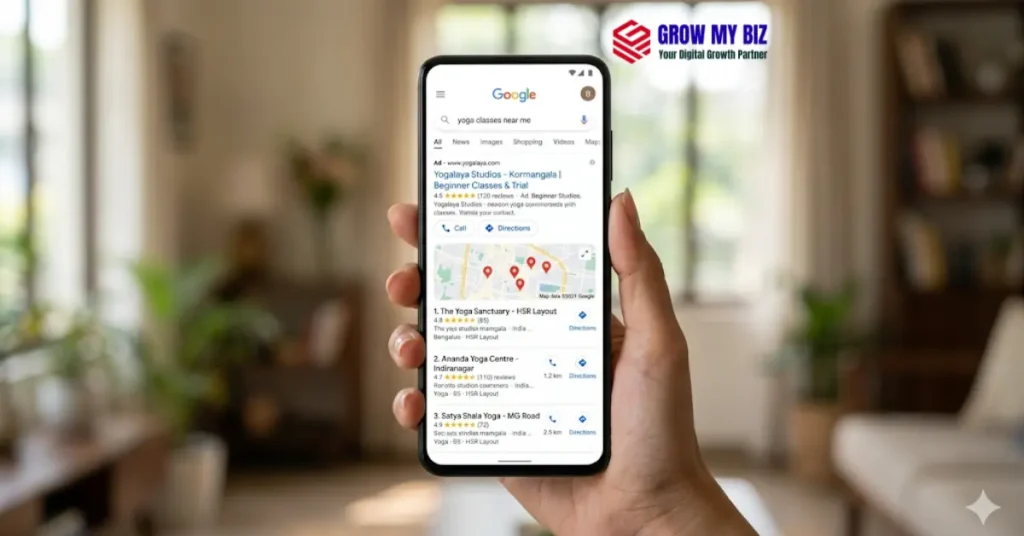
Organic SEO takes 6–12 months minimum. Instagram reaches people in a browsing mindset. Google Search catches people with intent — they are actively typing ‘yoga classes near me’ or ‘yoga studio in Indiranagar.’ That’s a buying signal, not a scroll.
If you want long-term organic visibility alongside your ads, read our guide on local SEO for yoga studios
Here’s the fundamental difference: social media interrupts. Search ads respond.
For a yoga studio trying to fill classes in the next 30 days, Google Ads for yoga classes is the most direct path. You can go live today and get inquiries by tomorrow. No algorithm games, no follower count needed.
In my experience, yoga studios that get this right see a cost-per-lead of ₹80–₹250 for local Search campaigns. That’s hard to beat with any other paid channel for a hyperlocal service business.
That said, Google Ads is not a magic tap. You still need a clear offer, a page that converts, and basic tracking. Without those three things, you’ll burn budget.
Also Read:- Digital Marketing for Physiotherapy Clinics in India
Want More Yoga Class Bookings from Google Ads?
When someone searches for “yoga classes near me”, they’re ready to join. Let Grow My Biz Digital run high-converting Google Ads that bring you consistent leads and new students.
Which Google Ads Campaign Type Should You Use?
Yoga studio owners often make the mistake of launching a Display or Performance Max campaign because someone told them it’s ‘smarter.’ That advice costs money.
Search Campaigns — Start Here
For local class bookings and trial inquiries, Search campaigns are your primary tool. You show up when someone types a query with real intent. Budget control is tight, results are measurable, and you can see exactly which keywords triggered your ad.
If you’d rather have this handled end-to-end, our PPC services in Delhi NCR cover full campaign management.
Local Service Ads (LSAs)
If you have a verified Google Business Profile, Local Service Ads can work well for ‘yoga classes near me’ type searches. You pay per lead, not per click. The downside: availability is still patchy across Indian cities, and the setup requires verification. Worth testing if it’s available in your city.
Related:- Meta Ads for Yoga Studios: Get More Leads, Trial Bookings & Students in 2026
Display Campaigns — Not for Beginners
Display is for remarketing — showing ads to people who already visited your website but didn’t convert. Running Display cold (to people who’ve never heard of you) for yoga is a waste for most studios. The click quality is low and the intent is near-zero.
Performance Max — Proceed with Caution
Google loves pushing Performance Max. I don’t love it for yoga studios at early stages. It’s a black box — you hand over control, and Google decides where to show ads. You often end up with Display and YouTube impressions that burn budget without producing bookings. Use it only once you have conversion data and a clear CPA target.
| Campaign Type | When to Use It |
| Search Campaign | Best for direct bookings & trial signups |
| Local Service Ads | Best for ‘near me’ queries if available |
| Display / Remarketing | Re-engage website visitors only |
| Performance Max | Only after 30+ conversions/month data |
| YouTube Ads | Brand awareness, not lead generation |
Keyword Strategy for Yoga Studio Google Ads in India
Most people running yoga studio advertising in India go too broad. They bid on ‘yoga’ and then wonder why they’re getting clicks from people looking for yoga pants on Flipkart or yoga mats on Amazon.
Your keywords need to be intent-specific and location-specific. Here’s how I categorize them:
High-Intent Transactional Keywords
These are your money keywords — people who are ready to join a class or at minimum make an inquiry.
- yoga classes near me
- yoga studio in [city/locality] — e.g., yoga studio in Koramangala
- yoga classes in [area]
- yoga classes for beginners in [city]
- morning yoga classes [city]
- prenatal yoga classes [city]
- hatha yoga / ashtanga yoga / vinyasa yoga classes [city]
Semi-Intent Keywords
People researching before deciding. Lower conversion rate but still worth targeting.
- yoga classes fees in [city]
- best yoga studio in [city]
- yoga instructor near me
- yoga membership [city]
Negative Keywords — Equally Important
What you exclude is as important as what you include. Add these as negatives from day one:
- yoga mat, yoga pants, yoga clothes, yoga wear — shopping intent, not service
- free yoga, yoga videos, yoga youtube — informational intent
- yoga teacher training course — different audience unless you offer TTC
- yoga certification — training seekers, not class takers
- yoga poses, how to do yoga — content consumers
For a complete keyword and on-page audit framework, refer to our yoga studio SEO checklist.
⚠ What I’ve seen fail most often: studios adding no negative keywords in their first month and watching 40% of their budget go to clicks that have zero chance of converting. Build your negative keyword list before you go live, not after.
Match Type Guidance
For yoga studio PPC in India, start with Phrase Match and Exact Match only. Broad Match will bleed your budget early in the campaign. Once you have 60+ days of data and a healthy negative keyword list, you can carefully introduce Broad Match Modified — but not before.
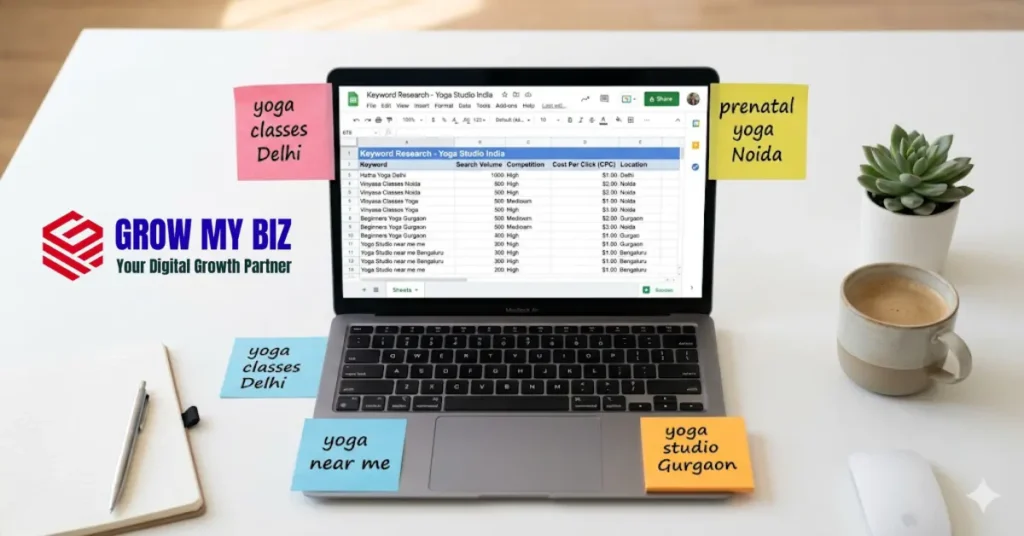
Recommended structure: 70% Exact Match + 30% Phrase Match in month 1. Review search terms report every week and add negatives aggressively.
For yoga studios in Pune specifically, see our dedicated Pune yoga marketing guide.
Writing Google Ads Copy That Actually Gets Yoga Leads
Most yoga ad copy reads like a brochure. ‘Best yoga classes.’ ‘Expert instructors.’ ‘Join our community.’ None of that is specific enough to make someone click over the next result.
The person searching is evaluating 3–4 options simultaneously. Your ad has about 1.5 seconds to make a case. Here’s what works:
Use Specificity Over Superlatives
‘Beginner-Friendly Yoga in Powai – First Class Free’ beats ‘Best Yoga Studio in Mumbai’ every single time. Specificity signals relevance. Superlatives are noise.
Headline Formula That Works
[Yoga Style/Goal] + [Locality] + [Hook/Offer]
- Morning Yoga Classes in Noida | Free Trial Class This Week
- Prenatal Yoga, Sector 15 Faridabad | Expert Instructors, Small Batches
- Yoga for Weight Loss in Delhi | Join 200+ Students – Book Now
Use All Available Ad Extensions
Extensions are free and increase your ad’s footprint. Don’t skip them.
- Sitelink extensions: link to specific class types, schedule page, trial offer
- Call extension: your studio number. Critical for mobile searches.
- Location extension: linked to your Google Business Profile
- Callout extensions: ‘AC Studio,’ ‘Certified Instructors,’ ‘Flexible Timings’
- Structured snippets: list class types — Hatha, Vinyasa, Pranayama, Meditation
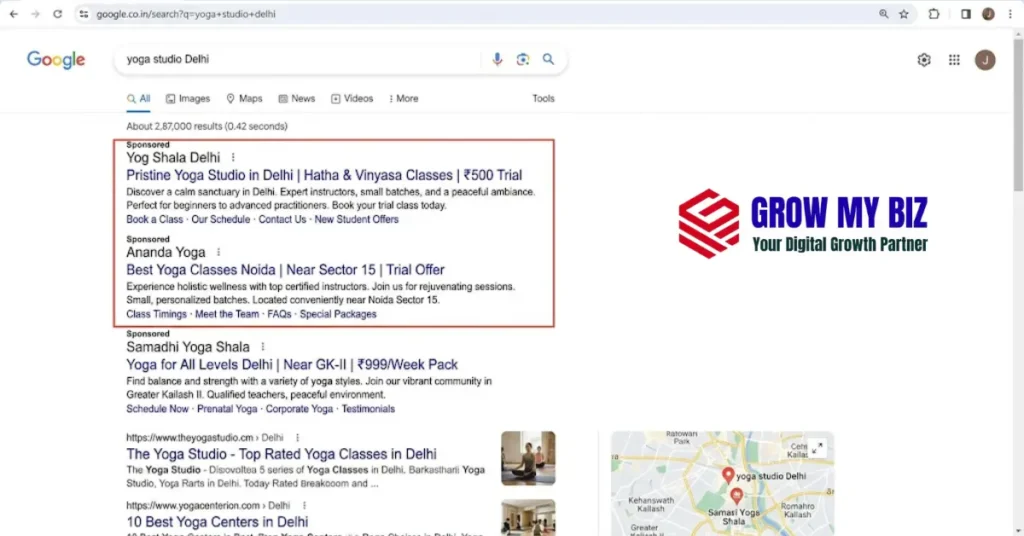
✓ Pro Tip: Enable call tracking from the first day. Many yoga inquiries come as direct calls, not form fills. If you’re not tracking calls, you’re measuring maybe 40% of your actual leads.
The Landing Page Problem — Why Most Yoga Studio Ads Fail Here
Here’s the brutal truth: 70% of the time when a yoga studio says ‘Google Ads doesn’t work,’ the issue is the landing page, not the ads. This is connected to a broader pattern we’ve documented — why yoga studios don’t get leads even with decent traffic.
Sending paid traffic to your homepage is usually a mistake. Your homepage serves too many purposes. A dedicated landing page has one job — convert that click into an inquiry or booking.
What Your Yoga Landing Page Must Have
- Headline that matches the ad — if the ad says ‘Morning Yoga Classes in Dwarka,’ the page should say exactly that, not something generic like ‘Welcome to Our Studio.’
- Clear offer above the fold — Free trial, free first class, introductory pack. Don’t make visitors search for your offer.
- Phone number prominent at the top — many people searching for local services want to call directly.
- Short inquiry form — Name, phone, class type preference. Nothing more. Every extra field reduces conversion rate.
- Social proof — Student testimonials with real names and photos. Before/after of a student’s yoga journey if possible. Review count from Google.
- Schedule or class timings — People need to know if your timing fits their routine before they commit.
- Location and locality name visible — Reinforce that you’re nearby.
⚠ Never send Google Ads traffic to a Justdial or Sulekha listing page. You paid for that click — don’t send the lead to a platform that will also show them your competitors.
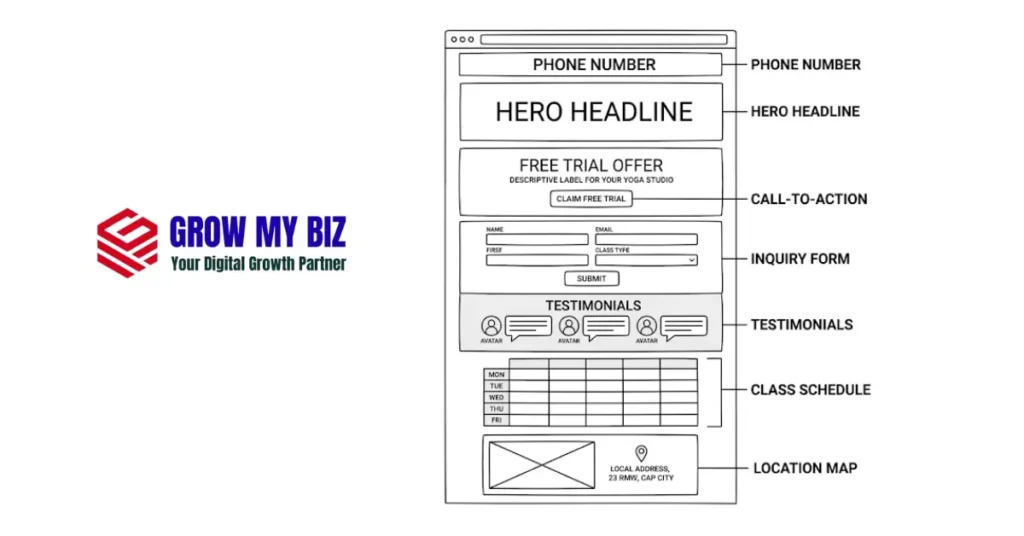
In my experience, studios that build a proper landing page (even a simple 5-section single-page site) see 2–3x better conversion rates than those sending traffic to their homepage or social profile. This is the single highest-ROI fix for most yoga ad campaigns.
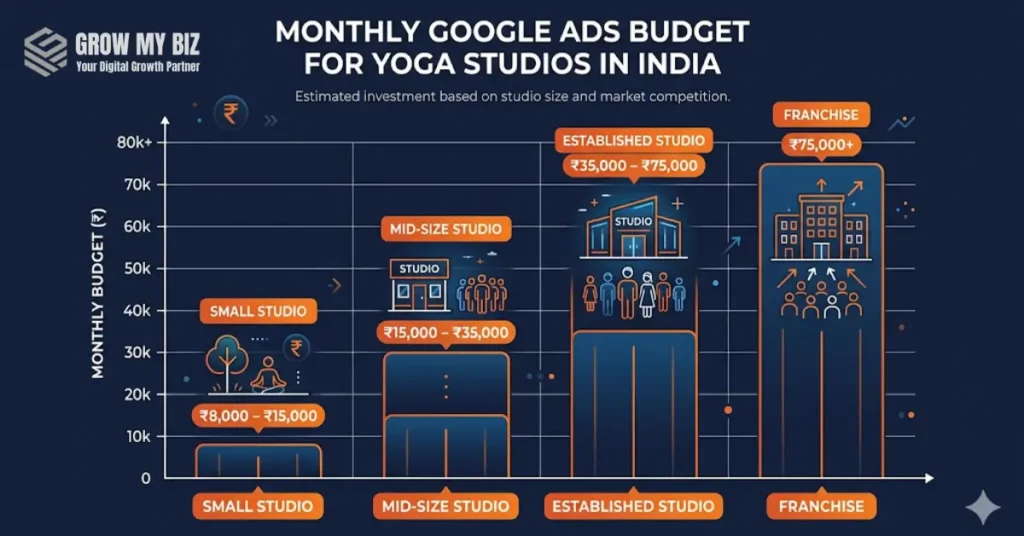
How Much Budget Do You Need for Google Ads for a Yoga Studio in India?
There’s no universal answer, but here’s a realistic framework based on actual campaigns I’ve run.
| Studio Type | Recommended Monthly Budget |
| Small studio, 1–2 locations, tier-2 city | ₹8,000 – ₹15,000/month |
| Mid-size studio, metro city, 2–3 class types | ₹15,000 – ₹35,000/month |
| Established studio, multiple programs, metro | ₹35,000 – ₹75,000/month |
| Franchise / multi-location | ₹75,000+/month (per region) |
Keep in mind: CPCs for yoga-related keywords in Indian metros typically range from ₹15–₹60 per click depending on competition and match type. At ₹15,000/month, you’re getting roughly 250–500 clicks — which is enough to generate 15–40 leads if your landing page converts decently.
A studio owner in Pune with 12 years of teaching experience can be completely outranked by a newer studio that simply understands how Google works. You can check our guide about SEO Tips for Yoga Practitioners: 35-Point Guide to Get More Students Online.
Budget Allocation Rule
For a new campaign, I recommend this split:
- 80% on Search campaigns — proven, direct intent
- 20% held back for remarketing Display — once you have 200+ site visitors to remarket to
Don’t run Display from day one. Build an audience first.
✓ Pro Tip: Set a daily budget cap, not just a monthly one. Google can spend 2x your daily budget on high-traffic days. If your monthly budget is ₹20,000, set daily to ₹600 (not ₹667) to give yourself a small buffer for overspend days.
Setting Up Google Ads for Local Yoga Classes — Step-by-Step
Step 1: Location Targeting
Don’t target an entire city. Target a radius around your studio. For most yoga studios, 5–8 km is realistic — people rarely travel more than that for a regular class. If you’re in a metro with good metro connectivity, you can stretch to 10 km.
In Ads settings: Campaign → Location → Enter address → Radius targeting → Set 5–8 km.
Make sure your GBP is properly optimized first — our Google Business Profile optimization service covers this completely.
Step 2: Ad Schedule
Run ads when people are actually searching for classes. For yoga specifically, searches spike at:
- 6:00–9:00 AM — morning routine searchers
- 12:00–2:00 PM — lunch break decision-makers
- 7:00–10:00 PM — evening planners
Turn off or reduce bids between 11 PM and 5 AM. Your studio isn’t open, and these clicks rarely convert.
Step 3: Device Targeting
Most local yoga searches happen on mobile. Check your device split after 2 weeks. If mobile is driving 70%+ of clicks (which it usually is), increase mobile bid adjustments by 20–30%.
Step 4: Conversion Tracking
This is non-negotiable. Set up at minimum:
- Form submission tracking (Google Tag Manager recommended)
- Call tracking (Google forwarding number via Ads platform)
- WhatsApp button click tracking if you have a WhatsApp CTA
⚠ Running Google Ads without conversion tracking is flying blind. You won’t know which keywords are generating leads and which are just eating budget. Set this up before your campaign goes live — not a week later.
Free Google Ads Strategy
Struggling to Get Consistent Yoga Class Leads?
People searching for “yoga classes near me” are ready to join today. With the right Google Ads strategy, Grow My Biz Digital helps you capture these high-intent leads and turn them into paying students.
Common Google Ads Mistakes Yoga Studios Make in India
I’ve audited dozens of yoga studio ad accounts. The same issues keep showing up.
Mistake 1: Too Many Campaigns, Too Little Budget
Running 5 campaigns with ₹10,000/month means each campaign gets ₹2,000. That’s not enough data for Google’s algorithm to learn or optimize. Consolidate into 1–2 focused campaigns and give them proper budget.
Mistake 2: Not Using the Search Terms Report
The Search Terms report (under Keywords → Search Terms) shows exactly what people typed before seeing your ad. Most studios open it once in 3 months. The best-performing studios check it every week and add negatives and new keywords based on what they see.
Mistake 3: Generic Ads for All Class Types
Advertising ‘yoga classes’ with one generic ad to everyone. If someone searches ‘prenatal yoga in Gurgaon,’ they should see an ad specifically about prenatal yoga, going to a page specifically about prenatal yoga. That’s called ad relevance — and it directly impacts your Quality Score and CPC.
Mistake 4: Ignoring Quality Score
Quality Score affects how much you pay per click. A QS of 8/10 can cost you 30–40% less per click than a QS of 4/10 for the same keyword. Most people focus on bid amounts and ignore QS. Your QS improves when: your ad is relevant to the keyword, your landing page is relevant to the ad, and people click your ad at a good rate (CTR).
Mistake 5: Stopping Too Early
Most people pause campaigns after 30 days and declare them failures. Google Search campaigns take 60–90 days to fully optimize — especially if you’re using smart bidding strategies like Target CPA. Give the campaign enough time and data before making final judgments.
Most people get this wrong because they treat Google Ads as an on/off switch. It’s actually a system that learns and improves with data. Stopping it at 30 days is like hiring a new employee and firing them in their first month because they weren’t performing at full speed yet.
What Results Should You Expect? A Realistic Performance Framework
Here are the benchmark numbers I work with when setting client expectations for yoga studio lead generation through Google Ads:
| Metric | Typical Benchmark |
| Click-Through Rate (CTR) | 4–8% for well-optimized Search ads |
| Landing Page Conversion Rate | 8–20% depending on offer and page quality |
| Cost Per Click (CPC) | ₹20–₹65 for local yoga keywords in metros |
| Cost Per Lead (CPL) | ₹80–₹300 depending on location and competition |
| Lead-to-Trial Conversion | 30–50% with proper follow-up |
| Trial-to-Member Conversion | 20–40% depending on studio and offer |
If your cost per lead is above ₹500 and not improving by month 2, something structural is wrong — typically the landing page or keyword targeting.
How to Calculate Your Max CPL
Work backwards from your LTV (Lifetime Value) of a member. If a member pays ₹3,000/month and stays for 8 months on average, their LTV is ₹24,000. Even at a 30% profit margin, you can afford ₹2,000+ to acquire one member. Most yoga studios are too conservative with their ad budget relative to the actual value of a retained student.
Google Ads vs. Organic SEO for Yoga Studios — What to Choose?
Short answer: you need both, but in the right order.
Use Google Ads to generate leads now while your SEO builds over 6–12 months. Once your SEO starts ranking pages (especially local pack rankings for ‘yoga studio in [area]’), you can gradually reduce ad spend on those specific terms and reinvest in harder keywords or new localities.
For the organic side of this equation, our yoga studio SEO services are built specifically for studios across Delhi NCR.
| Factor | Advantage |
| Speed of results | Immediate (24–72 hours) |
| Speed of results (SEO) | 6–12 months |
| Cost structure | Pay per click |
| Cost structure (SEO) | Time/agency fee, no per-click cost |
| Scalability | Scales with budget |
| Scalability (SEO) | Compounds over time |
| Best for | Filling classes now, new studio launch, promotions |
| Best for (SEO) | Long-term authority, recurring traffic |
The studios I’ve seen grow fastest in year 1 run both simultaneously: Google Ads for immediate lead flow, and SEO content (class pages, local landing pages, blog posts) for compounding returns. Neither alone is the full strategy.
When to Hire a Google Ads Expert or Agency for Your Yoga Studio
You can run Google Ads yourself if you’re willing to invest 5–8 hours/month learning and managing. The platform isn’t that complicated at the local campaign level. But there are situations where hiring a specialist pays off quickly:
- You’ve run ads before and spent ₹20,000+ without a single trackable lead
- You’re launching a new studio and can’t afford to waste the first 2–3 months learning
- You want to run campaigns across 2+ locations or 3+ class types simultaneously
- You want conversion tracking, remarketing, and proper Google Analytics integration
When evaluating a digital marketing agency for your yoga studio, ask these questions:
- Do you have experience running ads for local service businesses (not just ecommerce)?
- Can you show me a campaign structure you’d build for a yoga studio specifically?
- How do you track leads — forms, calls, WhatsApp?
- What’s your policy on budget ownership — do you keep the account if we stop working together?
- Do you report on Cost Per Lead or just click metrics?
If you’re evaluating agencies, start here: our digital marketing services for local businesses across Delhi NCR.
⚠ Red flag: any agency that doesn’t track leads or can only show you ‘impressions’ and ‘clicks’ as success metrics is not running your campaign properly. Impressions don’t pay your instructors.
Seasonality and Timing — When to Push Harder with Yoga Ads in India
Yoga studio enrollments are not flat throughout the year. Here’s what I’ve observed across Indian metro campaigns:
- January–February: New Year resolution wave. Highest search volume for beginner yoga, weight loss yoga. Best time to push trial offers.
- March–April: Pre-summer uptick, especially for women’s wellness and weight management.
- September–October: Post-monsoon, pre-festive reset. Good conversion season.
- November: Solid. Pre-winter fitness motivation.
- May–July: Dip in most cities. Summers reduce outdoor movement. Lean towards online/hybrid class ads.
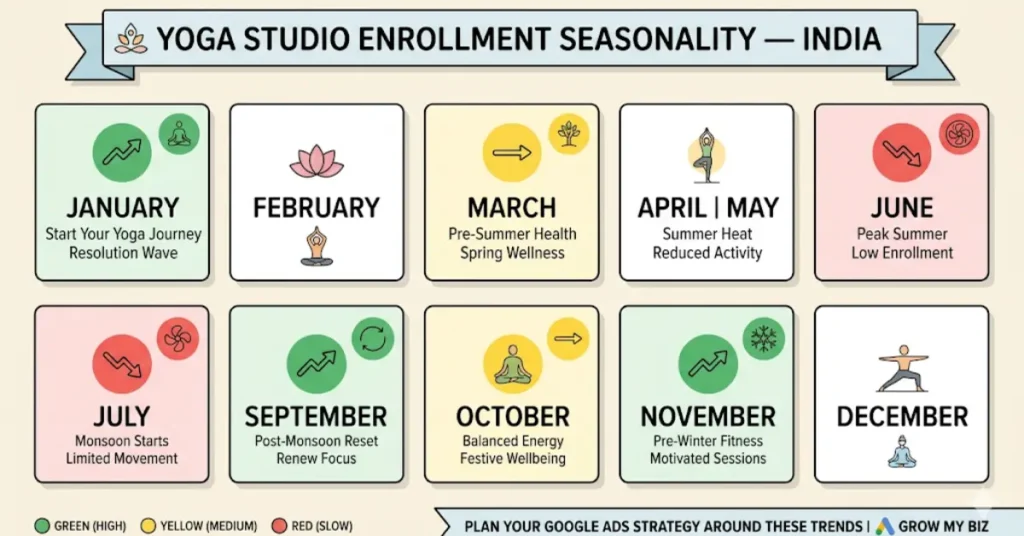
During peak months (January, September, November), increase your daily budget by 30–50% and add seasonal messaging: ‘Start Your New Year Right,’ ‘Post-Festive Reset.’ During slow months, reduce spend but don’t stop completely — the people who convert in June are your highest-intent leads.
Our local SEO services in Delhi handle both the technical and content side for yoga studios.
Low Budget vs. High Budget Strategy: What Changes?
Small studio owners often assume Google Ads is only for big budgets. It’s not. But your strategy has to change depending on what you have to spend. Here’s the honest breakdown.
Low Budget (₹8,000–₹15,000/month)
With a tight budget, every rupee has to work harder. The strategy: go narrow and go deep.
- Target 1 locality only — the 5 km radius around your studio. Do not spread thin across a full city.
- Run 1 campaign, 1 ad group, 10–15 tightly themed exact and phrase match keywords only.
- Use Manual CPC bidding — not Smart Bidding. At low budgets, Google’s smart bidding doesn’t have enough data. You’ll waste the first 3 weeks in learning phase.
- One strong offer only: free trial class or introductory 1-week pack. Don’t confuse visitors with multiple options.
- Schedule ads only during peak hours (6–9 AM, 7–10 PM). You can’t afford wasted budget on low-intent daytime traffic.
Higher Budget (₹30,000+/month)
Once you have budget headroom, build a proper full-funnel setup.
- Multiple ad groups segmented by class type: beginner, prenatal, weight loss, corporate yoga — each with tailored ads and dedicated landing pages.
- Remarketing Display campaign for site visitors who didn’t convert — allocate 15–20% of total spend here.
- Switch to Target CPA bidding once you hit 30+ conversions/month — the algorithm has enough data to optimize meaningfully at that point.
- Expand radius to 2–3 nearby localities. Run competitor keyword campaigns targeting branded searches for rival studios in your area.
Want Consistent Leads for Your Yoga Studio?
People searching “yoga classes near me” are ready to book instantly. With the right Google Ads strategy, Grow My Biz Digital helps you attract high-intent students and fill your batches faster.
Google Ads Strategy: Low Budget vs. High Budget
| Feature | Low Budget (₹8,000–₹15,000/mo) | High Budget (₹30,000+/mo) |
| Primary Goal | Survival & Immediate Leads | Brand Authority & Scalability |
| Location Targeting | Hyperlocal: Only 3-5 km radius | Regional: 10 km+ or Multiple localities |
| Keyword Strategy | Narrow & Deep (10-15 keywords) | Broad & Categorized (By class types) |
| Match Types | Exact & Phrase Match only | Mix of Phrase, Exact, & some Broad |
| Bidding Strategy | Manual CPC (More control) | Smart Bidding (Target CPA / Max Conversions) |
| Ad Structure | 1 Focused Campaign | Multiple Campaigns (Prenatal, HIIT, TTC) |
| Remarketing | No (Avoid wasting budget) | Yes: Display/Video ads for past visitors |
| Landing Page | Single Page with 1 Strong Offer | Multi-page / Personalized for each service |
Having a higher budget doesn’t mean you should increase your wastage. While a high-budget strategy leverages automation and remarketing to scale, a low-budget approach requires ‘surgical precision’ to ensure every rupee spent converts into a lead.
One More Thing: Add Urgency to Your Ad Copy
The headline formula mentioned earlier — [Yoga Style] + [Locality] + [Hook] — works even better with a fourth element: urgency. Batch sizes are genuinely limited for yoga studios. Use that honestly.
- “Only 4 Slots Left — Morning Yoga Batch, Sector 15 Faridabad | Book Free Trial”
- “New Batch Starting Monday — Prenatal Yoga Noida | Limited Seats”
One rule: only use urgency when it’s real. If you’re permanently “almost full” but never actually full, people stop believing you. Genuine scarcity converts. Manufactured scarcity erodes trust.
Real Campaign Result (Anonymous, South Delhi) A yoga and wellness studio in South Delhi was running Google Ads on a ₹18,000/month budget, generating leads at ₹350–₹420 CPL. The account had no negative keywords, was running Broad Match across 3 campaigns, and sending traffic to the homepage. After restructuring into a single Search campaign with exact and phrase match keywords, building a dedicated trial class landing page, and adding 60+ negative keywords, the CPL dropped to ₹95–₹120 within 6 weeks — on the same budget. Class bookings went from 4–5 per month to 22–28 per month.
Final Thoughts: The Only Google Ads Strategy That Actually Works for Yoga Studios
Google Ads for yoga studios is not complicated. What makes it fail is the same thing that makes most local business advertising fail: treating it like a launch button instead of a system.
The studios that consistently fill their batches through paid search are not the ones with the biggest budgets. They’re the ones who got three fundamentals right: targeted keywords that match real buying intent, an ad that earns the click with a specific offer, and a landing page built to convert — not just to look nice.
Everything else — the bid strategy, the campaign type, the budget split — is secondary to those three. Fix those first, and the rest becomes much easier to optimize.
One practical action right now: if you’ve already run ads, open your Search Terms report and count how many irrelevant queries triggered your ads. That number will tell you more about why your campaigns underperformed than any other metric. If you haven’t started yet, build your negative keyword list before you go live. That one step alone will save you ₹3,000–₹8,000 in your first month.
Google Ads is not a shortcut. But it is the fastest legitimate path to filling your yoga batches when set up properly. At ₹100–₹250 per lead and a member LTV of ₹20,000–₹30,000, the math works comfortably in your favor — as long as you give the campaign the structure, time, and attention it needs to perform.
Your studio is doing good work. Make sure the right people in your city can actually find it.
Need Help Running Google Ads for Your Yoga Studio?
We manage local Google Ads campaigns for yoga studios, wellness centers, and fitness businesses across Delhi NCR, Mumbai, Bengaluru, and beyond.
growmybiz.in | sachin@growmybiz.in | +91-7827333577
Frequently Asked Questions: Google Ads for Yoga Studios in India
How much does Google Ads cost for a yoga studio in India?
A realistic starting budget is ₹10,000–₹20,000/month for a local campaign in a metro city. Tier-2 cities can work with ₹8,000–₹12,000/month. The minimum viable budget to generate meaningful data and leads is ₹8,000/month — below that, you’re not getting enough clicks to optimize.
What keywords should I use for yoga studio Google Ads?
Focus on local, intent-rich keywords: ‘[yoga style] classes in [locality],’ ‘yoga studio near me,’ ‘yoga classes for beginners [city].’ Pair these with strong negative keywords to exclude shopping, informational, and training-related searches.
Can I run Google Ads for a yoga studio without a website?
Technically yes — you can use Google’s ad-hosted landing pages. But the conversion rate is far lower than a proper dedicated landing page. A basic one-page website built for lead capture will outperform any ad-hosted page. Even a simple page built on Google Sites or a landing page builder like Unbounce or Carrd works better than no page.
How long before I see results from Google Ads for yoga classes?
With a well-structured campaign and a converting landing page, you should see the first leads within 3–7 days of going live. Meaningful optimization data takes 4–6 weeks. Don’t evaluate campaign performance in the first 2 weeks — the algorithm is still in learning phase.
What is a good cost per lead for yoga classes in India?
For local Search campaigns targeting yoga classes, ₹100–₹250 is a healthy CPL for metro cities. Above ₹400 CPL consistently means something needs fixing — usually the landing page, keyword targeting, or both. Below ₹80 CPL is excellent and usually indicates strong local demand with low competition.
Should I use Google Ads or Facebook Ads for my yoga studio?
Google Ads captures intent-driven searches (‘I want yoga classes now’). Facebook/Instagram reaches people who might become interested. Both can work, but for immediate class bookings and consistent lead flow, Google Search ads typically outperform social ads for yoga studios — especially in smaller localities where social ads have thin targeting options.