

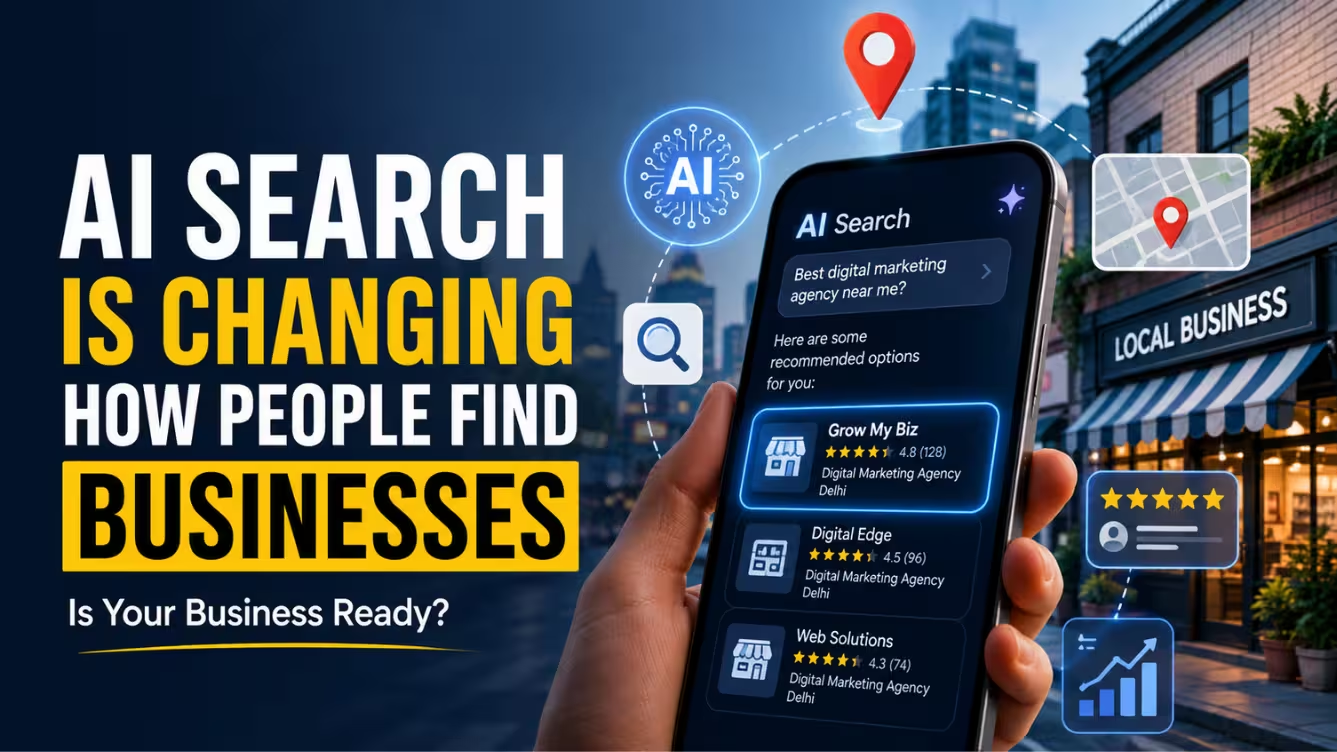
For years, getting found online meant one thing for most local businesses: rank on Google.
A customer searched for a dentist, restaurant, lawyer, physiotherapist or digital marketing agency, and the businesses that appeared near the top of Google Search or Google Maps had the best chance of getting the call.
That model is changing.
Today, people can ask Google an increasingly conversational question, open AI Mode, use an AI assistant such as ChatGPT or Gemini, or ask for a recommendation instead of searching through a traditional list of links.
The important question for a local business is no longer simply:
“How do I rank higher on Google?”
It is becoming:
“Can search and AI systems understand what my business does, where it operates, and why a customer should trust it?”
That distinction could become increasingly important as AI becomes part of how consumers discover products, services and businesses.
Table of Contents
Search Is Becoming More Conversational
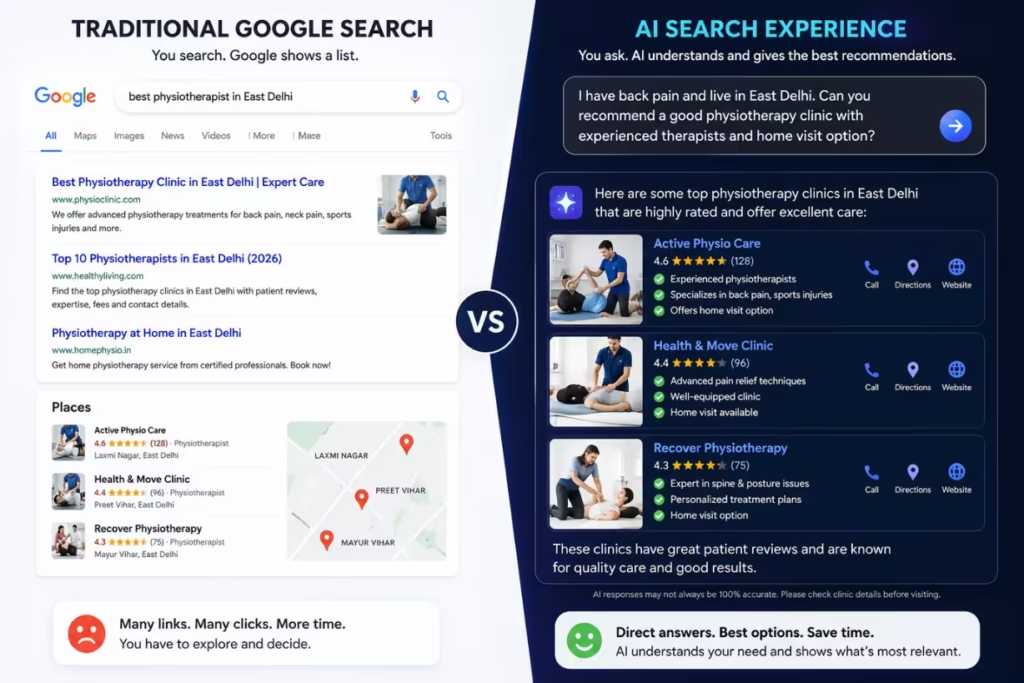
Traditional Google Search was built around keywords.
Someone might search:
“dentist in Delhi”
or:
“best physiotherapist near me.”
The search engine then returned a collection of websites, Maps results, advertisements and other features.
AI-powered search changes the interaction.
Instead of breaking a problem into several searches, a person can ask something closer to how they would speak to another person:
“I have back pain and live in East Delhi. Can you recommend a physiotherapy clinic that has good reviews and offers home visits?”
That query contains several pieces of intent at once:
- the service
- the problem
- the location
- the customer’s preference
- the desired outcome
Google says AI Mode is specifically designed for more complex questions, exploration, comparisons and follow-up conversations. Its AI features can also use a technique called query fan-out, where related searches are performed across multiple subtopics and sources before generating a response.
That creates a different discovery environment for businesses.
The customer may not begin with a business name.
They may begin with a problem.
And the AI system may help decide which businesses become part of the solution.
Google Search Is Already Moving in This Direction
This isn’t a distant prediction.
Google has been building AI into Search through AI Overviews and AI Mode, and the company has continued expanding these experiences throughout 2025 and 2026.
Google says AI Overviews and AI Mode are designed to help people explore information and discover relevant websites. In May 2026, Google also announced additional ways for people to discover original content and trusted sources through its AI Search experiences.
The scale is significant.
Google reported in 2026 that AI Overviews had more than 2.5 billion monthly active users, while AI Mode had surpassed one billion monthly users. Google also said AI Mode queries had more than doubled every quarter since launch.
For businesses, the takeaway isn’t that traditional Search has disappeared.
It hasn’t.
The takeaway is that the search journey is becoming more complicated and more conversational.
And local businesses need to understand where they fit into that journey.
What Does AI Search Actually Mean for a Local Business?
Imagine two local businesses.
Both have websites.
Both have Google Business Profiles.
Both have five-star reviews.
Both offer the same service.
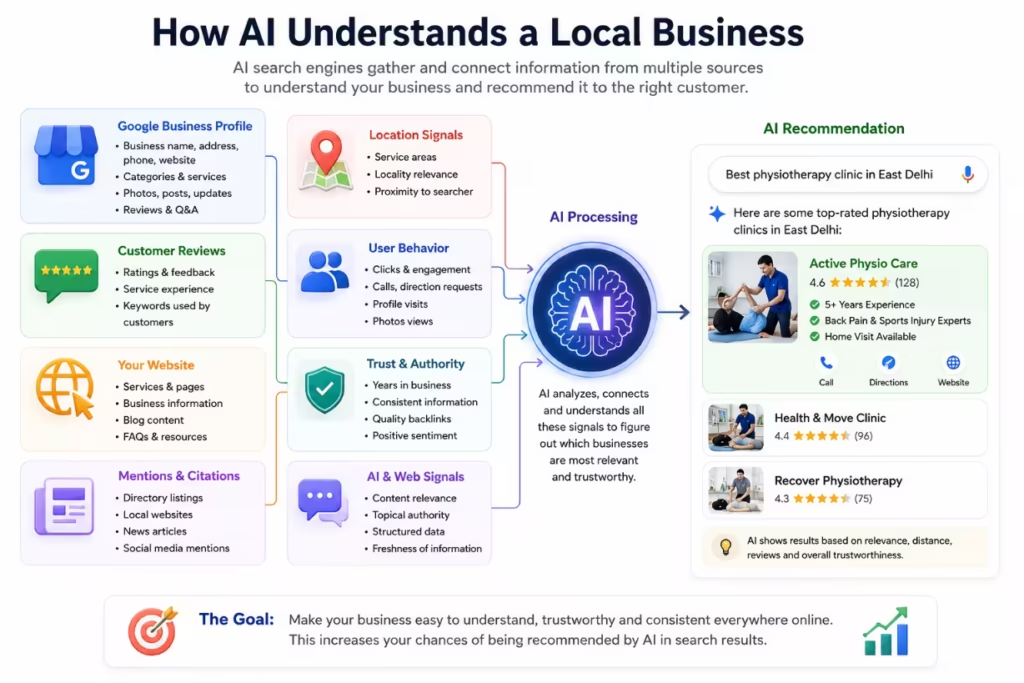
But one business has a clear and consistent digital footprint:
- its website clearly explains its services
- its location and service areas are consistent
- its Business Profile is complete
- customers regularly mention its services in reviews
- reputable websites mention the business
- its contact information is consistent
- its website contains useful, original information
- its social profiles reinforce the same business identity
The second business has contradictory information across different websites, an outdated profile, thin website content and very little evidence about what makes it different.
If an AI system has to understand these two businesses, the first one gives the system considerably more coherent information to work with.
This doesn’t mean there is a secret formula that guarantees an AI recommendation.
There isn’t.
But it does mean that clarity, consistency, relevance and corroboration are becoming increasingly important concepts in AI-driven discovery.
Check our comprehensive guide about Local SEO for Law Firms in India.
Your Google Business Profile Matters More Than Ever
One of the biggest mistakes a local business can make is treating its Google Business Profile as a separate marketing asset.
It isn’t.
Google says information shown in Business Profiles can come from several sources, including the business itself, publicly available web content, third-party data, users, reviews, photos and Google’s own interactions with a local place.
Think about what that means.
Suppose your Business Profile says one thing, your website says another, an old directory contains a third version, and customers describe your services differently.
The problem isn’t merely an SEO inconsistency.
It can make your business harder to understand.
For a local company, the basics therefore matter:
Business name: consistent and accurate.
Address: accurate wherever applicable.
Service area: clearly defined.
Phone number: current and consistent.
Website: accessible and informative.
Services: clearly explained.
Reviews: genuine and regularly accumulated.
Photos: current and relevant.
Google itself recommends keeping Business Profile information accurate and up to date and maintaining a truthful representation of the business.
AI Doesn’t Just Need Your Website
This is where the traditional idea of SEO starts becoming too narrow.
A business owner might think:
“I’ll publish more blogs and optimize my keywords.”
That can still be useful.
But local visibility increasingly depends on the broader digital footprint of the business.
Your website is one source.
Your Google Business Profile is another.
Reviews are another.
Directories and other websites can provide additional signals.
Customers can contribute photos and information.
News articles, local publications, professional profiles and other legitimate mentions can add context.
Google itself explains that local business information can be compiled from publicly available information, licensed data, user contributions and other sources.
This creates a simple principle:
Don’t try to make one website say everything. Build a consistent digital identity across the web.
The New Local SEO Question: Can AI Understand Your Business?
Consider a restaurant.
Its website says:
“We are a restaurant.”
That’s not particularly useful.
Now imagine the website clearly explains:
- North Indian cuisine
- family dining
- vegetarian options
- private dining
- catering
- location
- opening hours
- reservation process
- signature dishes
- customer questions
- real photographs
- authentic customer experiences
The business has given search systems substantially more context.
The same principle applies to a lawyer, doctor, salon, gym, school, clinic, home renovation company or digital marketing agency.
Be specific about what you do.
Be specific about who you serve.
Be specific about where you operate.
Be specific about why customers choose you.
That is good marketing regardless of whether the visitor arrives through Google, Maps, ChatGPT or another AI system.
Reviews May Become More Important Than Businesses Realize
Reviews have always mattered for local businesses.
For example, Google Reviews can provide important context about the real customer experience around a local business.
We have seen the same principle across local SEO campaigns, where reviews, GBP activity and customer experience all contribute to local visibility.
But AI-driven discovery makes the language inside those reviews potentially more interesting.
Compare these two reviews:
“Great service. Highly recommended.”
with:
“We hired this interior designer for our 3BHK renovation in Noida. They handled the modular kitchen, false ceiling and complete electrical work and finished the project within the agreed timeline.”
The second review provides much more context.
It describes:
- the service
- the location
- the project type
- the scope
- the customer’s experience
Businesses should never manipulate customers into writing reviews or manufacture review language.
But they should make it easy for genuine customers to describe their real experience.
And they should respond to reviews professionally.
Google’s Business Profile tools explicitly support collecting and responding to customer reviews, alongside managing business information and publishing photos and videos.
Your Website Still Matters
There is a dangerous misconception spreading around AI Search:
“SEO is dead because AI answers everything.”
Google’s own guidance says otherwise.
Google states that the same SEO fundamentals still matter, even as the search experience becomes more AI-driven. Pages still need to be crawlable, indexable and eligible for Search, and Google recommends fundamentals such as internal linking, useful text, good page experience, high-quality media and accurate structured data.
So don’t abandon SEO.
Instead, broaden your understanding of it.
Traditional SEO asks:
Can Google rank this page?
Modern search strategy increasingly asks:
Can search systems understand, trust and connect this information to the right user intent?
Those are not competing objectives.
They overlap.
What Local Businesses Should Do Now
If you own a local business, you don’t need to panic and rebuild your entire marketing strategy around AI.
Start with the fundamentals.
1. Fix Your Business Information
Check your:
- business name
- address
- phone number
- website
- opening hours
- service areas
- categories
- services
Make sure important information is accurate.
Google specifically recommends that businesses represent themselves accurately and consistently in the real world and online.
2. Make Your Website Extremely Clear
Don’t make visitors or search systems guess what you do.
A strong local business website should clearly communicate:
What you offer
Where you offer it
Who you help
How your service works
Why customers choose you
How customers can contact you
3. Create Useful Service Pages
Don’t create dozens of nearly identical pages just to target keywords.
Instead, build genuinely useful pages for your important services and locations.
On-page SEO also helps make those service and location pages clearer to search engines.
A physiotherapy clinic might have:
- Physiotherapy
- Sports injury treatment
- Home physiotherapy
- Back pain treatment
- Physiotherapy in East Delhi
But every page should provide genuinely useful information rather than simply swapping city names.
4. Strengthen Your Google Business Profile
Keep it updated.
Add accurate services.
Use relevant photos.
Maintain current hours.
Respond to reviews.
Add appropriate links where available.
Google says Business Profiles can help customers find businesses on Search and Maps and can direct them to websites, booking links and other actions.
5. Earn Genuine Mentions
If respected local websites, publications, industry organizations or relevant businesses mention your company naturally, that can strengthen the broader digital footprint around your brand.
Don’t confuse this with mass directory submission or buying hundreds of low-quality links.
The objective is recognition and corroboration, not volume.
6. Publish First-Hand Information
This may become one of the biggest opportunities for smaller businesses.
Don’t publish another generic article titled:
“10 Benefits of Digital Marketing.”
Instead, share what you actually know.
For example:
“We Audited 50 Google Business Profiles. These Were the Most Common Problems.”
Or:
“What We Learned From Fixing Suspended Business Profiles.”
Or:
“Why Some Delhi Businesses Get Calls From Google Maps While Similar Businesses Don’t.”
Your experience is difficult for competitors to copy.
There Is One New Risk: AI Can Get Your Business Wrong
AI Search creates opportunity, but it also introduces a new reputation problem.
Recent reporting has highlighted cases where AI-generated Google summaries contained inaccurate or misleading information about small businesses, sometimes apparently mixing information from different businesses or relying on outdated sources.
This is an important warning.
You shouldn’t assume:
“If AI says something about my business, it must be correct.”
It doesn’t.
AI systems can make mistakes.
That’s why businesses should periodically search for themselves across major search and AI experiences and check whether the information being surfaced is accurate.
If an AI system consistently misunderstands what your company does, the solution isn’t necessarily to “optimize for AI” with some magic markup.
Start by asking:
Is the correct information actually clear and consistent across the web?
Don’t Waste Money on “Secret AI SEO”
As AI Search becomes more popular, a new industry of tools and services will inevitably promise:
“Get your business recommended by ChatGPT.”
Be careful.
No legitimate SEO consultant can guarantee that ChatGPT, Gemini, Google AI Mode or another AI system will recommend a particular business for every query.
Even Google’s own documentation says there are no additional technical requirements or special optimizations required specifically to appear in AI Overviews or AI Mode. The foundation remains strong technical SEO and helpful, reliable, people-first content.
There is no magic “AI ranking switch.”
There is no guaranteed AI recommendation button.
And there is no replacement for having a genuinely strong business.
AI Search Doesn’t Kill Local SEO. It Expands It.
This may be the most important point in the entire discussion.
Traditional local SEO isn’t becoming irrelevant.
It is becoming part of a larger discovery ecosystem.
Your Google Business Profile still matters.
Your website still matters.
Your reviews still matter.
Your reputation still matters.
Your local authority still matters.
Your content still matters.
But now there are more ways for customers to discover that information.
A customer might find you through:
Google Maps → Google Search → AI Overview → AI Mode → ChatGPT → Gemini → another website → a review → a social profile.
The journey isn’t necessarily linear anymore.
And that means local businesses need to stop thinking exclusively about ranking for keywords.
They should start thinking about becoming the obvious, trustworthy answer to a customer’s problem.
The Local Business That Wins the AI Search Era
Imagine a customer asks:
“Who is the best digital marketing agency for a small business in Delhi?”
You don’t want an AI system to find one page on your website saying:
“We are the best digital marketing agency in Delhi.”
You want the broader web to tell a coherent story.
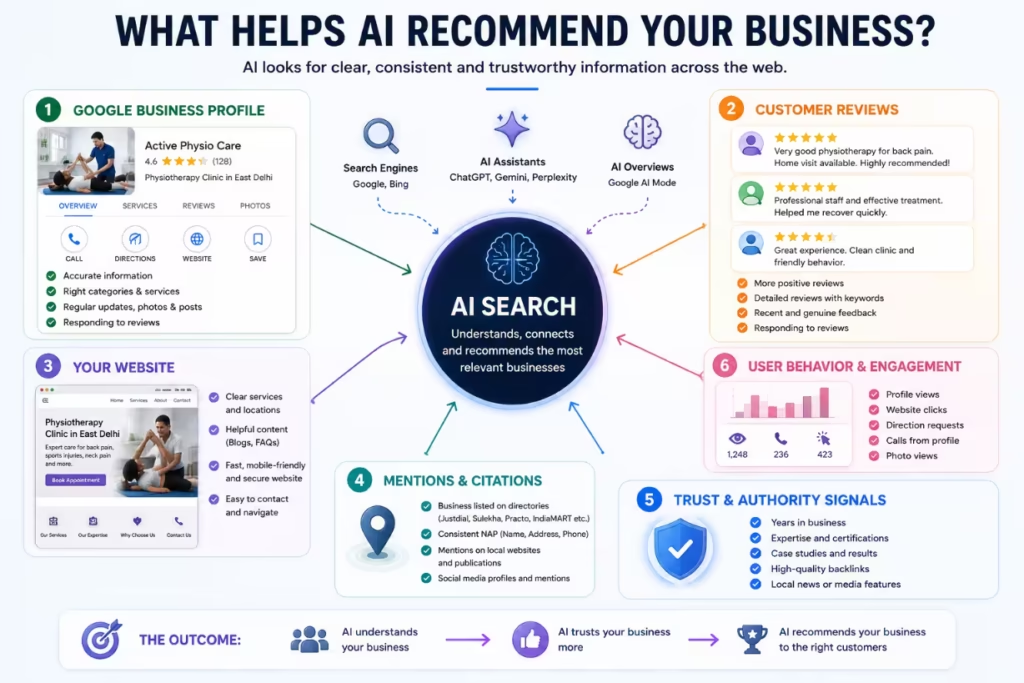
Your website explains your services.
Your Business Profile confirms your location and category.
Your reviews describe real customer experiences.
Your content demonstrates expertise.
Together, these signals contribute to stronger local search visibility.
Relevant websites mention your work.
Your business information is consistent.
Your case studies show results.
Your social presence reinforces your identity.
And when a search system tries to understand your company, there is enough reliable information available to form a clear picture.
That’s a much stronger position than simply trying to rank one page for one keyword.
What Should You Do This Month?
If you’re a local business owner, don’t start by chasing every new AI platform.
Do these five things first:
1. Audit your Google Business Profile.
Make sure the business information is accurate and complete.
2. Audit your website.
Can someone understand what you do, where you operate and who you serve within a few seconds?
3. Check your online consistency.
Look at your website, Google profile, major directories and social profiles.
4. Strengthen your reputation.
Collect genuine customer reviews and respond to them professionally.
5. Publish something only you can say.
Share original experience, case studies, observations, research or useful insights.
These actions aren’t only useful for AI Search.
They’re good marketing.
And that’s exactly why they matter.
Final Thought
AI Search may change the interface through which people discover businesses.
It may change how questions are asked.
It may change how recommendations are presented.
It may even reduce the importance of some traditional search behaviors.
But one thing hasn’t changed:
People still want reliable businesses that solve real problems.
The technology deciding how those businesses are discovered is simply becoming more sophisticated.
So don’t build your marketing strategy around trying to trick an AI into mentioning you.
Build a business that is easy to understand, easy to verify and genuinely worth recommending.
Because in the AI Search era, being visible is only half the battle. Being understandable and trustworthy may be the bigger one.




Great breakdown on scaling client acquisition! One of the biggest bottlenecks for agencies today is managing subscriptions for 3-4 different tools just to scrape data and run outreach. We built OmniLeadsPro to solve exactly this by combining a 2-step Google Maps extractor with built-in Meta WhatsApp and SMTP email outreach engines into a single desktop platform.