

QUICK ANSWER: GEO (Generative Engine Optimization) for IVF clinics means structuring your clinic’s content — success rates, doctor credentials, treatment explanations — so AI tools like ChatGPT, Perplexity, and Google AI Overview cite your clinic when patients ask fertility-related questions, instead of a competitor.
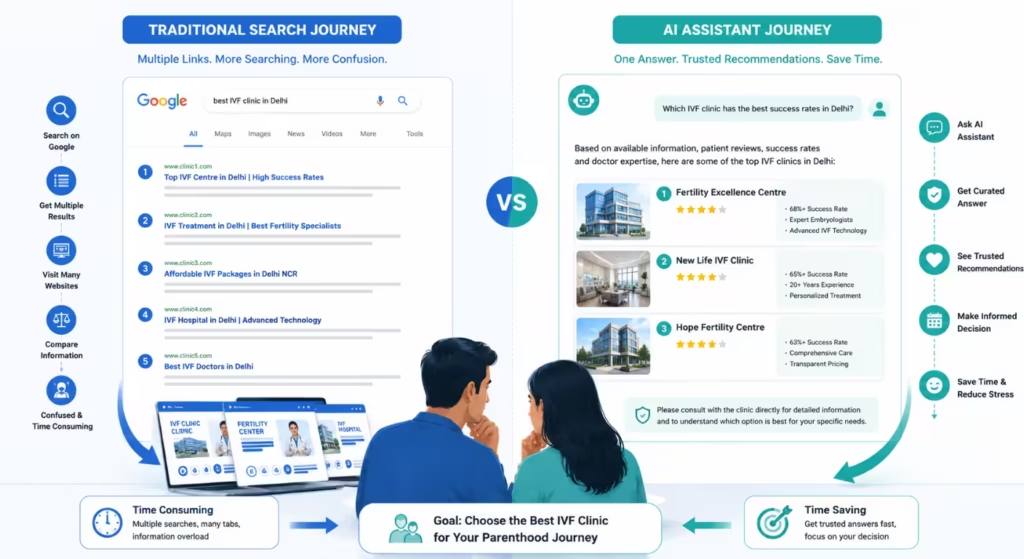
A patient in India researching IVF no longer stops at Google. Increasingly, they open ChatGPT and ask questions like ‘which IVF clinic has the best success rates in Delhi’ or ‘what should I ask before choosing a fertility clinic’ — and the AI gives a direct answer, often naming only two or three clinics. The question every Indian fertility clinic should be asking is: why does the AI recommend certain clinics and ignore others?
The answer is a discipline called Generative Engine Optimization (GEO) — and almost no fertility clinic in India is currently doing it. This guide explains what GEO actually involves, what published research says about how patients are already using AI for fertility decisions, and — unlike most GEO content available today, which relies on hypothetical examples — shows real, verified results from our own IVF content.
At a Glance
- SEO helps patients find your clinic.
- GEO helps AI systems recommend your clinic.
- The strongest digital strategies combine both.
Table of Contents
What Is GEO and Why It Matters for Fertility Clinics Specifically
QUICK ANSWER: SEO helps you rank in Google’s list of results; GEO helps you get cited directly inside an AI-generated answer. For IVF clinics, this distinction matters because fertility patients are unusually research-heavy, private, and increasingly turning to AI tools for sensitive questions they may not ask a doctor or family member directly.
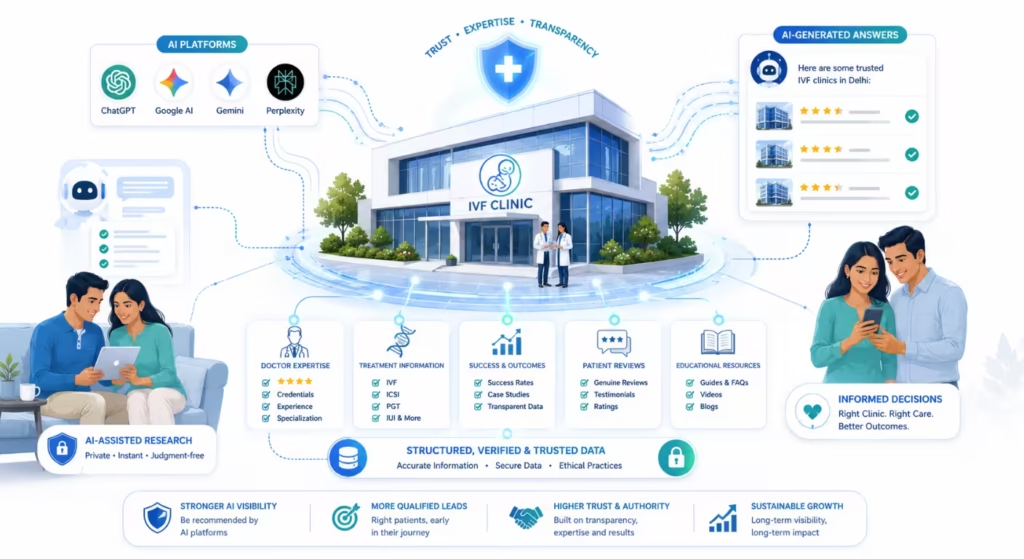
Traditional SEO optimises a page to appear in a ranked list of blue links. GEO optimises content so that AI systems — ChatGPT, Perplexity, Gemini, and Google’s AI Overview — extract and cite it directly when generating an answer. A clinic can rank reasonably well on Google and still be completely invisible inside an AI-generated answer, because the two systems evaluate content differently. You can check our IVF SEO Checklist : Complete Guide to Ranking Fertility Clinics on Google.
SEO vs GEO for IVF Clinics
| Feature | Traditional SEO | Generative Engine Optimisation (GEO) |
| Primary goal | Rank higher in Google Search | Increase the likelihood of being cited in AI-generated answers |
| Where patients discover you | Google Search results | ChatGPT, Google AI Overview, Gemini, Perplexity and other AI assistants |
| Main outcome | More website visits | Greater visibility during AI-assisted research |
| Success metric | Rankings, clicks and organic traffic | AI mentions, citations and inclusion in AI-generated responses |
| Optimisation focus | Keywords, backlinks, technical SEO | Structured content, entities, authority and answer-first information |
| Patient journey | Patients compare multiple websites | AI may recommend only a small number of sources |
| Best suited for | Capturing active Google searches | Influencing earlier-stage research before a clinic shortlist is formed |
| Relationship | Essential | Complements SEO rather than replacing it |
Fertility care is a particularly high-stakes case for GEO. IVF is an emotionally difficult, private, and expensive decision. Patients research for months, often without telling family or friends, which makes AI tools — private, judgement-free, available at 2 a.m. — a natural fit for the questions they are not ready to ask anyone else. SEO (Search Engine Optimization) is the process of improving your website’s visibility on search engines like Google so potential customers can find your business at the exact moment they are searching for your products or services.
What Research Actually Shows About Patients Using AI for Fertility Decisions
QUICK ANSWER: A study published in Human Reproduction found ChatGPT capable of synthesising multi-source answers to complex fertility questions — but flagged that its accuracy depends heavily on what accurate content exists online for it to draw from, meaning a clinic’s own published content directly shapes what the AI tells patients.
This is not a speculative trend. A peer-reviewed study in Human Reproduction tested ChatGPT against real fertility-related questions and found it wove together information that would normally require several separate Google searches into a single, coherent answer. Separately, a study in Fertility and Sterility evaluated ChatGPT as a fertility counselling tool against established clinical benchmarks like CDC FAQs, and found it performed credibly on informational questions.
Both studies flagged the same risk that matters directly for clinic marketing: where reliable information is scarce online, ChatGPT’s answers can skew toward whatever content is most available — including clinic marketing pages, social posts, or forum discussions of uneven quality. In other words, if your clinic has not published clear, accurate, well-structured content, the AI is not staying silent about your specialty — it is answering from whatever content does exist, quite possibly a competitor’s.
Also Read:- Digital Marketing for Physiotherapy Clinics in India
Is Your IVF Clinic Visible in AI Search?
Find out how ChatGPT, Google AI Overview, Gemini and Perplexity currently see your clinic. Our complimentary AI Visibility Audit highlights your strengths, identifies missed opportunities, and shows practical ways to improve your clinic’s AI visibility.
How Do AI Tools Decide Which Clinics to Mention?
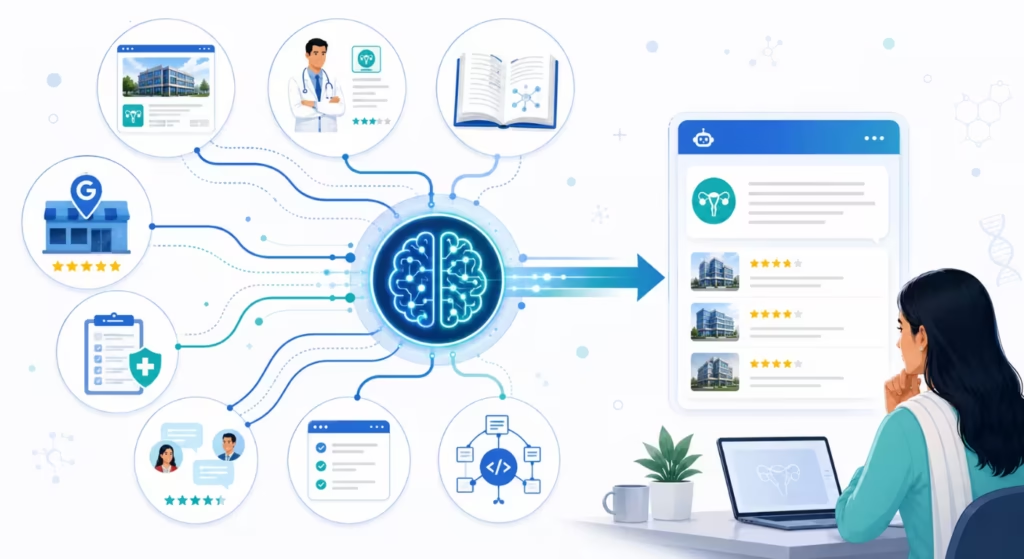
QUICK ANSWER: AI systems do not simply search the web like a traditional search engine. Depending on the platform, they may combine trained knowledge, live web search, retrieval systems, organised data, and trusted third-party sources to generate an answer. Clinics that publish clear, well-organised, and authoritative information are generally easier for these systems to understand and reference.
Although every AI platform uses its own methods, they share an important characteristic: they perform better when reliable information is readily available. A clinic with detailed treatment pages, identifiable doctors, consistent business information, evidence-based data, and independent validation gives AI systems far more confidence than one with only promotional marketing copy. GEO therefore focuses on making high-quality information easier for both people and AI systems to discover, interpret, and trust.
Please check our guide if your Google Business Profile Edits Not Showing? Here’s What’s Actually Happening.
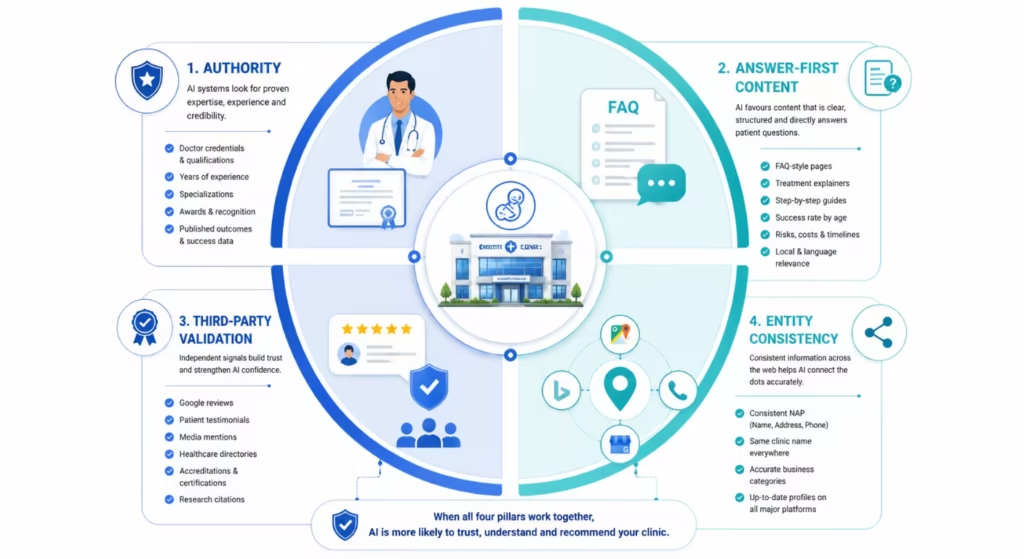
The Four Factors That Influence Whether AI Cites Your Clinic
QUICK ANSWER: AI systems weigh authority, well-organised and specific content, third-party validation, and consistent entity information across the web — a clinic strong on self-promotion but weak on these four factors is unlikely to be cited, regardless of how good its actual clinical outcomes are.
1. Demonstrated Authority
AI systems look for signals that a source genuinely knows the subject — doctor credentials, registration numbers, published outcomes, and specific rather than vague claims. A page stating ‘we provide excellent fertility care’ gives an AI system nothing concrete to cite. A page stating a specific, honestly sourced success rate by age group gives it something to work with.
2. Structured, Answer-First Content
AI retrieval favours content organised into clear questions and direct answers, with specific numbers and comparisons — not long, unstructured marketing copy. This is exactly why FAQ-formatted, quick-answer content consistently performs better for AI citation than a traditional ‘About Us’ style page.
3. Third-Party Validation
A clinic’s own website claiming excellence carries less weight with AI systems than genuine Google reviews, mentions in healthcare directories, or citations from other credible sources. Two clinics with identical clinical outcomes will not get equal AI visibility if one has 150 genuine reviews and public recognition and the other has almost none.
4. Consistent Entity Information
If your clinic is called ‘ABC Fertility Centre’ on your website, ‘ABC IVF’ on Google Business Profile, and ‘ABC Reproductive Medicine’ on a directory listing, AI systems struggle to consolidate authority around a single, recognisable entity. NAP and naming consistency — long a Local SEO fundamental — turns out to matter just as much for GEO.
What AI Systems Prefer
| AI is More Likely to Trust… | AI is Less Likely to Trust… |
| Clearly identified doctors with qualifications | Anonymous or generic clinic pages |
| Specific treatment information | Broad marketing claims |
| Age-specific success rate explanations | Unsupported statements like “best IVF centre” |
| FAQ-style answers | Long promotional copy |
| Consistent clinic name across all platforms | Different business names across directories |
| Genuine patient reviews | Very few or obviously artificial reviews |
| Structured data and schema markup | Pages with little or no structured information |
| References from trusted third-party websites | Information found only on the clinic’s own website |
Real Results — Not Hypothetical Examples
Most GEO content available today illustrates these ideas with a hypothetical ‘Clinic A vs Clinic B’ comparison. We can show something more useful: verified results from our own IVF content, visible directly in Google Search Console.
| Page | What Was Done | Verified Result |
| Kolkata IVF clinic page | Structured, entity-consistent local content with topical IVF depth | Ranked page 1 within 2 hours of publishing; now Position 3-4 for 6+ IVF queries |
| Same Kolkata page | Same semantically organised approach applied to one page | Also captured visibility for gynaecologist, sexologist, and urologist searches in the same city — evidence AI and Google both reward structured entity content beyond the exact target query |
| Local SEO for IVF Clinics guide | FAQ-structured, answer-first content with E-E-A-T signals | 1,700+ impressions, Position 6.4 |
| IVF SEO Checklist | Clear, scannable, direct-answer format | 1,400+ impressions, Position 6.8 |
This is the same underlying principle GEO research describes — machine-readable, specific, entity-consistent content earns both stronger traditional rankings and better AI citation eligibility. We are not asking clinics to trust a hypothetical scenario; this is what the approach has already measurably done.
Note: These results are not presented as proof that GEO alone caused the improvement. Rather, they demonstrate that evidence-based, entity-focused content can achieve rapid search visibility while also creating the kind of information architecture AI systems are designed to interpret.
Will GEO Actually Bring More IVF Patients?
QUICK ANSWER: GEO should not be viewed as a replacement for SEO or Google Ads, but as an additional source of patient discovery earlier in the decision-making journey. Its value lies in increasing the likelihood that your clinic becomes one of the trusted sources AI systems reference while prospective patients are still researching treatment options.
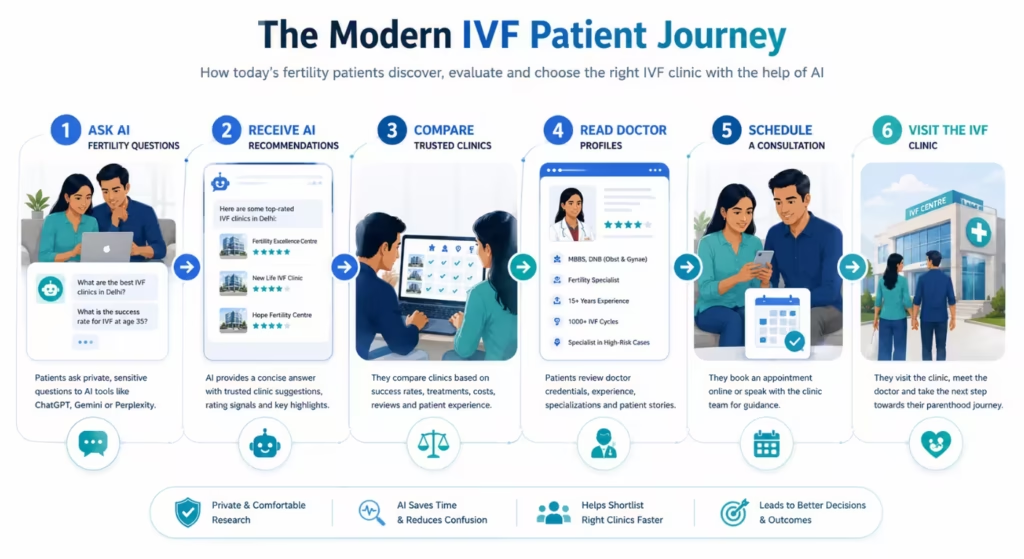
Unlike a Google search, where a patient may compare ten websites before contacting a clinic, AI-generated answers often highlight only a small number of providers or sources. Being cited during this research stage does not guarantee an enquiry, but it increases the chance that your clinic enters the patient’s shortlist before competitors they may never have otherwise discovered.
For IVF clinics, where patients often spend weeks or months researching success rates, treatment options, and doctor expertise before making contact, visibility during this early information-gathering phase can influence which clinics receive the first enquiry. GEO therefore supports patient acquisition by improving visibility at the point where trust is beginning to form—not by replacing the channels that convert enquiries into appointments.
Also Read:- Digital Marketing Agency for IVF Clinics in Jaipur
How Patients Research IVF Today
| Traditional Patient Journey | AI-Assisted Patient Journey |
| Searches Google | Opens ChatGPT or Gemini |
| Visits 8–10 websites | Reads one AI-generated answer |
| Compares clinics manually | AI summarises the comparison |
| Reads multiple blogs | Receives a concise explanation |
| Creates a shortlist | AI may already suggest a shortlist |
| Contacts several clinics | Often contacts one or two clinics first |
How Long Does GEO Take to Show Results?
QUICK ANSWER: GEO is not an overnight marketing tactic. While individual pages can sometimes be indexed and gain search visibility quickly, consistent AI visibility usually develops as a clinic publishes authoritative, structured content over time and strengthens its overall online entity.
Unlike paid advertising, GEO has no switch that instantly increases visibility. AI systems evaluate information from multiple sources, making consistency more important than speed. Clinics that publish comprehensive treatment pages, maintain accurate business information, improve well-organised data, and earn genuine third-party mentions are generally better positioned for long-term AI citation.
Based on our own IVF content and broader SEO experience, the first measurable improvements in search visibility may appear within weeks, while stronger topical authority and AI visibility typically develop over several months as more high-quality content is published and recognised.
Please check our IVF Digital Marketing Cost in Delhi (2026 Breakdown): SEO, Google Ads & Patient Acquisition.
Discover Why Competitor Clinics Get Recommended by AI
AI systems don’t recommend clinics randomly. We analyse your competitors, identify why they appear more prominently in AI-generated answers, and provide a practical roadmap to help your clinic strengthen its online authority.
What Happens If My Clinic Ignores GEO?
QUICK ANSWER: Choosing not to optimise for AI does not prevent AI systems from answering fertility-related questions—it simply means those answers are more likely to rely on information published by other clinics or organisations.
As AI-assisted research becomes more common, clinics that consistently publish accurate, structured, and trustworthy information are likely to become the sources patients encounter first. Clinics that delay may still perform well in traditional Google search, but could become less visible during the earlier research phase where patients compare treatment options and providers.
GEO is therefore less about reacting to a future trend than preparing for an observable shift in how patients increasingly discover medical information.
If you want to get More Patients Online, check our guide about Digital Marketing for Doctors.
Can Larger IVF Chains Dominate GEO?
QUICK ANSWER: Not necessarily. Unlike traditional marketing, where larger budgets often create greater visibility, GEO appears to reward the quality, structure, and credibility of information more than the size of the organisation publishing it.
A well-structured page explaining IVF success rates by age group, written by qualified specialists and supported by clear references, may be more useful to an AI system than a generic marketing page published by a much larger clinic. This gives independent fertility centres an opportunity to compete by demonstrating expertise rather than simply increasing advertising spend.
The advantage is not guaranteed—larger organisations often possess stronger authority signals—but smaller clinics can narrow the gap significantly through better structured, evidence-based content. You can check our Digital Marketing Agency for IVF Clinics in Kolkata — Get More Patient Enquiries Online.
90-Day GEO Roadmap for IVF Clinics
| Timeline | Priority | Recommended Action | Expected Outcome |
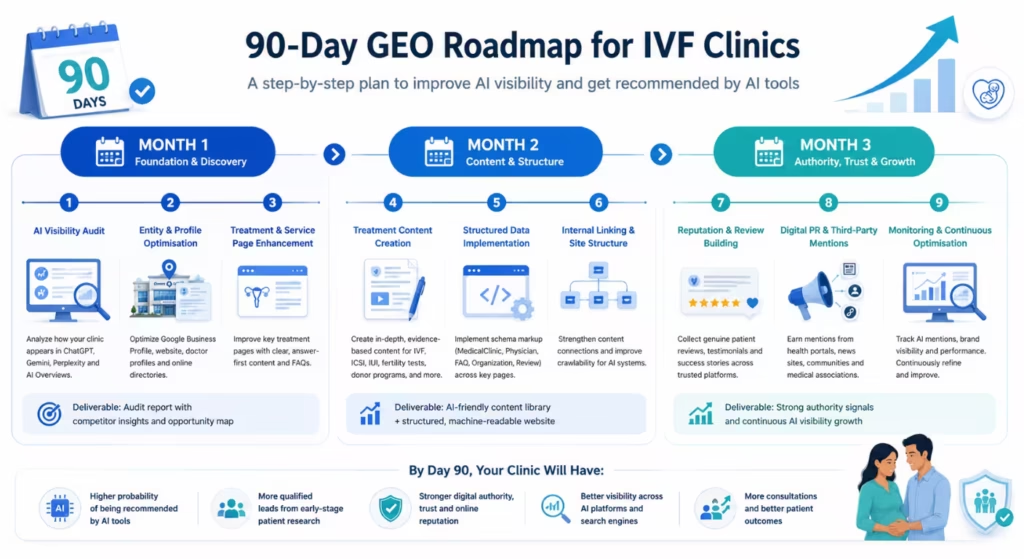
| Week 1 | Audit | Test your clinic across ChatGPT, Gemini, Perplexity and Google AI Overview | Understand your current AI visibility |
| Week 2 | Entity Optimisation | Standardise clinic name, address, phone number and doctor information | Stronger entity consistency |
| Weeks 2–4 | Content | Publish detailed treatment pages and patient FAQs | Greater topical authority |
| Month 2 | Structured Data | Add MedicalClinic, Physician and FAQ schema | Easier AI interpretation |
| Month 2 | Reputation | Increase genuine Google reviews and third-party mentions | Improved trust signals |
| Month 3 | Expansion | Create city-specific and treatment-specific pages | Broader AI and search visibility |
| Ongoing | Monitoring | Regularly test AI responses and update content | Maintain and improve AI visibility |
How Much Does GEO Cost?
QUICK ANSWER: There is no fixed cost because GEO is a content and optimisation strategy rather than a standalone product. The investment depends on the size of the clinic, the number of locations, the amount of existing content, and the competitiveness of the local market.
Some clinics begin with an AI visibility audit and improvements to existing pages, while others require a broader strategy involving new treatment pages, FAQ content, structured data implementation, Local SEO, and ongoing content development. The important consideration is not the initial cost but whether the clinic is building a long-term digital asset that continues attracting patients beyond individual advertising campaigns.
For most fertility clinics, GEO works best alongside Local SEO, reputation management, and carefully structured educational content rather than as a standalone marketing activity.
Build a GEO Strategy That Delivers Long-Term Results
Whether you’re launching a new IVF centre or improving an established clinic, we develop customised GEO strategies that combine AI visibility, Local SEO, structured content, and reputation management to support sustainable patient growth.
Common GEO Mistakes IVF Clinics Make
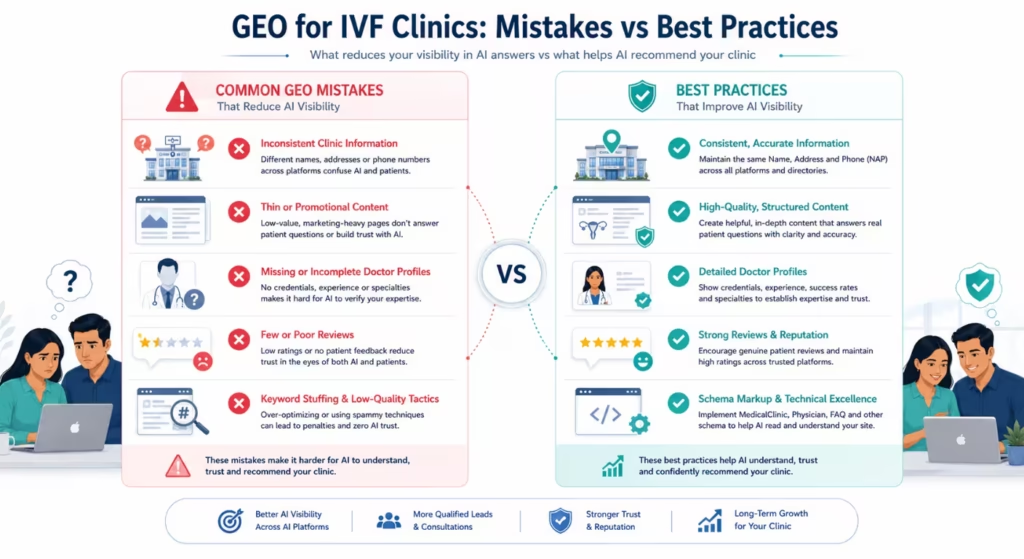
QUICK ANSWER: Most IVF clinics do not struggle with GEO because they lack medical expertise—they struggle because the information they publish is difficult for both patients and AI systems to understand. The most common mistakes involve treating GEO as another keyword exercise rather than building trustworthy, well-structured, and evidence-based content.
1. Treating GEO as “AI Keyword Optimisation”
Some clinics assume GEO simply means adding phrases such as “ChatGPT optimisation” or “AI SEO” throughout their website. In reality, AI systems are far more influenced by the quality, clarity, and authority of information than by the repeated use of AI-related keywords. Writing naturally for patients remains far more effective than writing for algorithms.
Please check our complete Digital Marketing for IVF Centers: Understanding Growth, Trust, and Patient Discovery in 2026.
2. Publishing Promotional Content Instead of Educational Content
Pages built entirely around claims such as “best IVF centre” or “highest success rates” provide very little useful information for AI systems to reference. Clinics that explain treatment options, eligibility criteria, risks, timelines, and realistic expectations are generally more useful sources than those relying primarily on marketing language.
3. Inconsistent Clinic Identity Across the Web
Many clinics use one name on their website, another on Google Business Profile, and a different variation across healthcare directories and social media platforms. These inconsistencies make it more difficult for AI systems to associate authority with a single, well-defined entity. Consistent naming, contact details, and doctor information remain fundamental to both Local SEO and GEO.
4. Hiding Doctor Expertise
Patients choose fertility specialists—not anonymous websites. AI systems also look for signals that qualified professionals are behind published medical information. Detailed doctor profiles, qualifications, registrations, areas of expertise, and authored educational content all strengthen credibility.
5. Publishing Thin Treatment Pages
Many clinic websites dedicate only a few paragraphs to complex treatments such as IVF, ICSI, IUI, donor programmes, or fertility preservation. Comprehensive pages that answer the questions patients genuinely ask are far more valuable for both users and AI systems than short, generic descriptions.
6. Ignoring Structured Data
Even excellent content becomes harder for AI systems to interpret if important information lacks clear structure. Implementing appropriate schema—such as MedicalClinic, Physician, FAQPage, and Organisation—helps search engines and AI systems identify key facts about the clinic, its doctors, and the services provided.
7. Depending Only on Your Own Website
AI systems evaluate information from multiple sources, not just a clinic’s own website. Google reviews, healthcare directories, medical associations, research publications, interviews, and reputable third-party mentions all contribute to a clinic’s overall digital authority. Clinics that rely solely on their own marketing pages often have fewer external trust signals for AI systems to consider.
8. Assuming GEO Replaces SEO
One of the biggest misconceptions is that GEO makes traditional SEO unnecessary. In reality, strong technical SEO, Local SEO, reputation management, and high-quality content remain the foundation upon which GEO builds. The clinics most likely to succeed in AI search are usually those with an already healthy digital presence—not those abandoning conventional optimisation.
Why GEO for Indian Fertility Clinics Needs an India-Specific Approach.
Avoiding these common mistakes does not guarantee AI visibility, but it creates a far stronger foundation for both search engines and AI systems to understand, trust, and reference your clinic. For Indian fertility clinics, however, there is an additional consideration that many international GEO guides overlook: compliance with India’s regulatory framework governing reproductive healthcare. You can check our Advanced On-Page SEO Services guide.
At a Glance: Common GEO Mistakes
| Mistake | Better Approach |
| Stuffing AI-related keywords | Publish useful, evidence-based information |
| Writing only promotional pages | Create educational, patient-first content |
| Inconsistent clinic name and NAP | Maintain one consistent entity across all platforms |
| Minimal doctor information | Showcase qualifications, experience, and authorship |
| Thin treatment pages | Publish comprehensive, question-focused resources |
| No structured data | Implement MedicalClinic, Physician, FAQPage, and Organisation schema |
| Relying only on your website | Build genuine third-party authority and reviews |
| Treating GEO as a replacement for SEO | Use GEO alongside strong SEO and Local SEO foundations |
Why GEO for Indian Fertility Clinics Needs an India-Specific Approach
QUICK ANSWER: Unlike general GEO advice written for the US market, Indian fertility clinics must structure AI-facing content within the PC&PNDT Act’s restrictions on what can be publicly communicated about reproductive services — making compliant, structured content even more important than in markets without this restriction.
Every piece of GEO content written for the US market assumes a regulatory environment that does not apply in India. The Pre-Conception and Pre-Natal Diagnostic Techniques (PC&PNDT) Act, 1994, restricts what fertility clinics can publicly communicate — including content designed for AI citation. Success rate claims, patient testimonials, and any content that could be construed as related to sex selection all require careful, compliant framing that pure SEO or GEO advice from other markets does not address.
Our Social Media Marketing for IVF Clinics guide covers these compliance considerations in more depth — the same principles apply directly to how GEO-focused content should be structured and published.
Please check our Guide about Off-Page SEO Services.
Ready to Make Your IVF Clinic AI-Visible?
Patients are already using AI to research fertility treatments and compare clinics before booking consultations. Let’s ensure your clinic is positioned as a trusted source that AI systems can confidently recommend.
✔ Free Initial Consultation • ✔ AI Visibility Assessment • ✔ Personalised GEO Recommendations
A Practical GEO Starting Point for Indian IVF Clinics
| Priority | Action | Why It Matters |
| 1 | Test your current AI visibility | Ask ChatGPT, Perplexity, and Gemini fertility questions for your city — see if your clinic is mentioned, and what is said about it |
| 2 | Publish specific, honest success-rate content | Vague claims are ignored by AI retrieval; specific, well-sourced, age-bracketed data gets cited |
| 3 | Add FAQPage and MedicalClinic schema | Gives AI systems structured, unambiguous facts to draw from about your clinic and doctors |
| 4 | Fix NAP and entity-name consistency | Ensures AI systems consolidate authority around one recognisable version of your clinic’s name |
| 5 | Build genuine, PC&PNDT-compliant reviews and third-party mentions | Third-party validation is one of the strongest AI citation signals — and cannot be replicated by your own website content alone |
Final Thoughts — Getting Ahead of the AI Research Phase
Relatively few fertility clinics in India appear to be intentionally structuring their content for AI citation today. That creates an opportunity for clinics that begin building AI-friendly content before the practice becomes widespread. The clinics that start now — publishing clear, honest, specific answers to the questions patients are already asking ChatGPT and Perplexity — will be the ones AI systems reference as this behaviour becomes mainstream over the next 1-2 years.
Frequently Asked Questions — GEO for IVF Clinics
1. What is GEO and how is it different from SEO for an IVF clinic?
SEO optimises a page to rank in Google’s list of search results. GEO optimises content so AI tools like ChatGPT and Google AI Overview cite it directly when generating an answer. They share foundations — clear content, credibility signals, structured data — but GEO specifically targets being the source an AI references, not just a link in a results page.
2. Are Indian fertility patients actually using ChatGPT to research IVF clinics?
Published research strongly suggests this behaviour is real and growing. Studies in Human Reproduction and Fertility and Sterility both found ChatGPT capable of handling complex fertility questions credibly — and specifically noted that its answers draw from whatever content exists online, making a clinic’s own published content directly influential in what the AI tells patients.
Can a smaller, independent IVF clinic compete with larger chains in AI search?
Often more effectively than in traditional SEO. AI citation rewards structured, specific, well-sourced content and genuine third-party validation — not simply brand size or ad spend. An independent clinic that publishes honest, detailed success-rate content and builds genuine reviews can be cited ahead of a larger but less digitally structured competitor.
4. How long does it take to see results from GEO for a fertility clinic in India?
There is no standardised published timeline for GEO specifically, since it is an emerging discipline. Based on results from our existing IVF content cluster — where structured, topically deep content reached page 1 Google rankings within hours to days — the same structural principles applied for AI citation appear to compound over a similar 1-3 month window, though AI citation requires manual testing across tools rather than a single ranking dashboard.
5. Does GEO replace the need for Local SEO for IVF clinics?
No. GEO is an additional layer on top of strong Local SEO fundamentals — not a replacement. A clinic still needs Google Maps visibility and local citations to capture patients ready to search for a specific clinic by name. GEO addresses the earlier-stage, AI-mediated research phase that increasingly happens before that point.
6. Does ChatGPT choose IVF clinics based on paid advertising?
No publicly available evidence suggests that ChatGPT recommends clinics because they advertise with Google or OpenAI. Recommendations are influenced by the quality and availability of information the system can access, rather than advertising spend. While paid advertising remains valuable for patient acquisition, it serves a different purpose from GEO.