
Most yoga studio owners who come to me have already tried something for SEO.
They changed a few page titles. Added some keywords. Maybe posted on Instagram for a month. Then gave up because nothing moved.
The problem is never effort. It is sequence.
SEO for a yoga studio is not complicated — but it has an order. Do things wrong and you waste months. Do them right and a studio that is invisible on Google Maps can be in the top 3 within 90 days.
Everything in this Yoga Studio SEO checklist I have used with real yoga studios and wellness businesses across India. Not borrowed from an SEO textbook — from actual client work. Go through it section by section. Tick what is done. Fix what is not.
Table of Contents
Before You Start: Understand What You Are Actually Optimising For
Most yoga studio owners think SEO means ranking on Google Search. That is only half the picture.
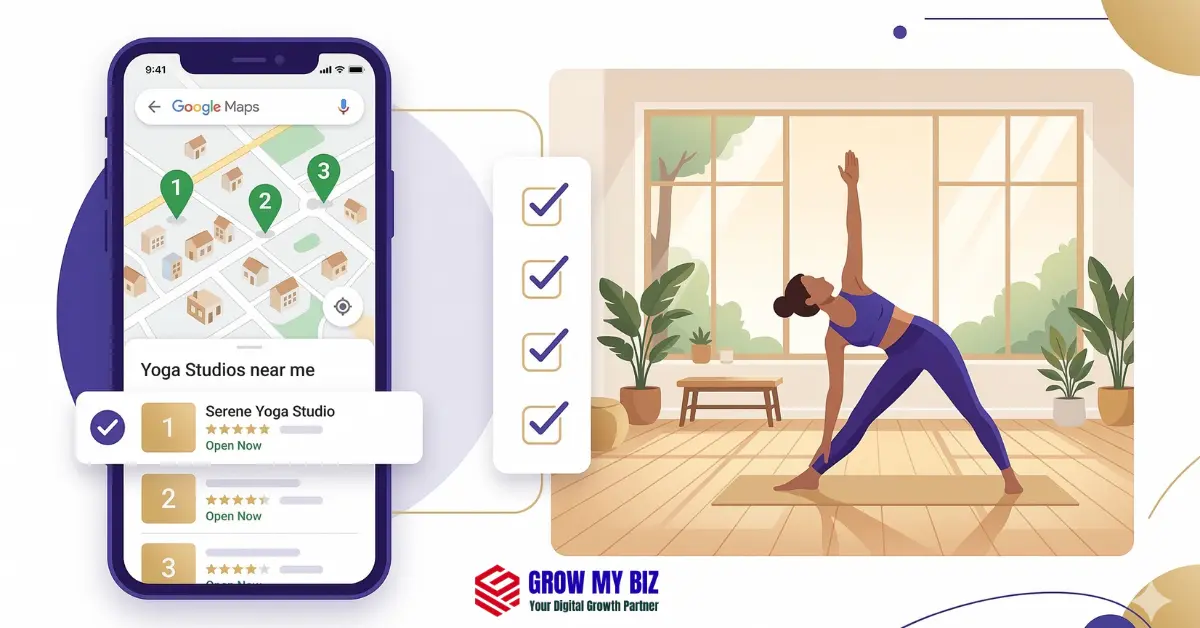
For a physical studio, Google Maps is where the real enquiries come from. When someone searches ‘yoga classes near me’ or ‘yoga studio in Laxmi Nagar’, they click the Map Pack — those top three listings — not the organic results sitting below them.
So, this checklist covers both:
- Local SEO — to rank in the Map Pack and location-based searches
- Website SEO — to rank in organic results and build long-term authority
Ignore either one and you are solving only half the problem.
Go through it, section by section. Start with GBP — that is where most ranking improvements come from. Content and backlinks come last.
SECTION 1 — Google Business Profile Checklist (13 Points)
GBP is the single highest-leverage thing a yoga studio can do for local visibility. I have seen studios go from zero Maps presence to consistent daily enquiries just by fixing their GBP — without touching their website.
Start here. Always.
☐ 1. Claim and verify your GBP listing
Go to business.google.com. If not done, nothing else on this list matters.
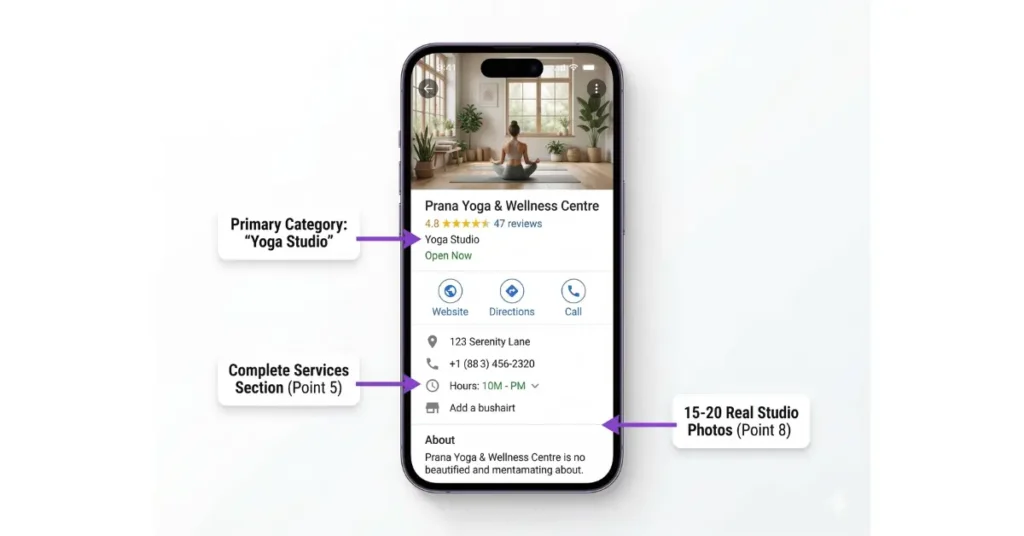
☐ 2. Set primary category to ‘Yoga Studio’
Not ‘Health & Wellness.’ Not ‘Fitness Centre.’ Yoga Studio — exactly that. This is the most common mistake I see, and it is the most damaging. The primary category is the strongest relevance signal in your entire GBP listing. Wrong category means wrong audience, wrong rankings, wrong enquiries.
☐ 3. Add 2-3 relevant secondary categories
Fitness Centre, Meditation Centre, Pilates Studio, Wellness Centre — add what genuinely applies. Each one adds a relevance layer Google uses to match you to related searches.
☐ 4. Write a keyword-rich business description (200-250 words)
Not a brochure. Not ‘we offer the best yoga classes in Delhi.’ Write it like you are explaining your studio to a neighbour — include types of yoga you teach, your target students, your locality, and nearby landmarks. A natural mention of ‘yoga classes in [your area]’ belongs here.
☐ 5. Add every service individually in the Services section
Hatha Yoga, Power Yoga, Prenatal Yoga, Kids Yoga, Corporate Yoga, Meditation, Therapeutic Yoga — each one separately. Most studios skip this entirely. It is one of the easiest wins on this entire list and takes 10 minutes.
☐ 6. Add accurate address and phone number — exactly as on your website
Character for character. This is NAP consistency. More on this in Section 3.
☐ 7. Set correct business hours and keep them updated
Outdated hours destroy trust faster than almost anything else. A student who calls during ‘open hours’ and gets no answer will not call again.
☐ 8. Upload minimum 15-20 real photos
Studio space, class in session, instructor headshot, certifications. Real photos — not stock images. In my experience, studios with 20+ real photos get 3-4x more profile views. Google also uses photo activity as an engagement signal.
☐ 9. Upload at least one video (30-60 seconds)
A studio tour or a student testimonial. GBP listings with video consistently outperform photo-only listings on click-through rate. Almost no yoga studio does this — which is precisely why it works.
☐ 10. Add landmark references in your description
‘Located 2 minutes from Rajiv Chowk Metro’ or ‘Opposite DLF Mall, Saket.’ People search this way on Maps — especially on mobile. Adding landmarks captures searches your competitors are completely missing and is one of the most underused tactics in local SEO.
☐ 11. Post on GBP at least once a week
Class schedule, new batch, yoga tip, student result. It does not need to be long — it needs to be consistent. What I have seen fail most often: studios post enthusiastically for the first month and then disappear. The algorithm notices and rankings plateau.
☐ 12. Seed your Google Q&A section
Ask the common questions yourself and answer them. ‘Do you offer beginner yoga classes?’ ‘What are the batch timings?’ ‘Is there a free trial?’ Each answer adds keyword-rich content to your listing and handles objections before the student even calls.
☐ 13. Add Hindi content in your description (1-2 sentences)
Hindi searches like ‘sabse accha yoga center Delhi’ or ‘yoga class paas mein’ are real and almost completely uncontested. One Hindi sentence in your GBP description puts you ahead of 95% of studios targeting the same area. This is the vernacular SEO opportunity almost everyone ignores.
GBP optimisation is just the foundation. For a complete breakdown of how Google Maps ranking actually works — citations, reviews, website signals, and everything in between — read our detailed guide on Local SEO for Yoga Studios.
SECTION 2 — Website SEO Checklist (14 Points)
Your website and GBP work together — Google cross-checks them constantly. A GBP that says South Delhi with a website that never mentions South Delhi is a trust gap that directly hurts your rankings.
☐ 14. Make sure your website exists
I say this without irony. A surprising number of yoga studios try to run entirely off Instagram. You can rank on Maps without a website — but you cannot hold that position long-term. A website gives Google the signals it needs to be confident in your relevance.
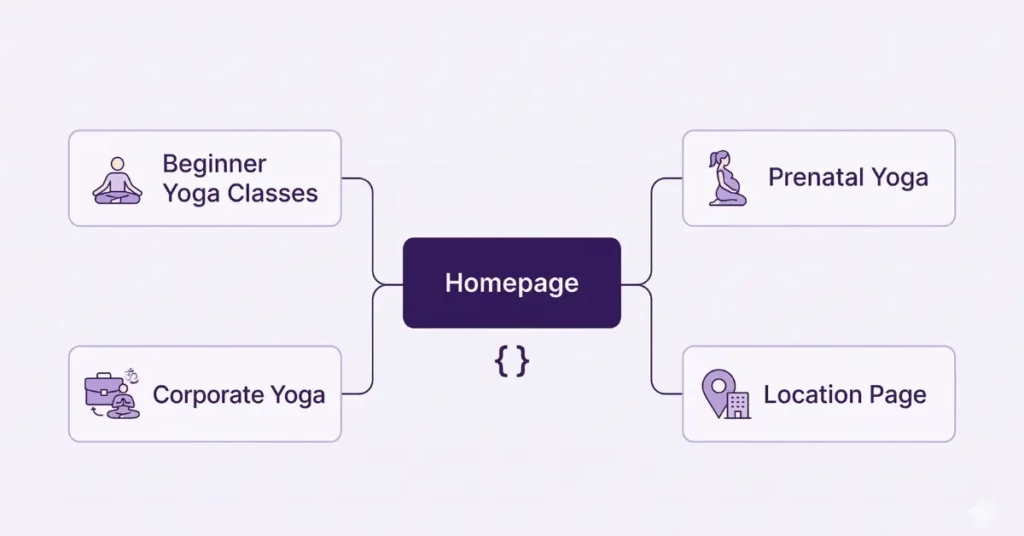
☐ 15. Build separate pages for each class type
One homepage cannot rank for 15 different keywords. Build dedicated pages for: Beginner Yoga, Power Yoga, Prenatal Yoga, Corporate Yoga, Meditation. Each page is a separate ranking opportunity — treat it that way.
☐ 16. Create a dedicated location page for each area you serve
A real location page — not 150 words with the area name stuffed in. Include: class types offered, batch timings, directions with a Maps embed, nearby landmarks, and real student testimonials from that locality. Thin location pages actively hurt more than they help.
☐ 17. Add LocalBusiness schema markup
This tells Google your exact business type, location, hours, and services in structured data. At minimum include: business type (YogaStudio), name, address, phone, URL, opening hours, service list. On WordPress, Rank Math or Yoast handles this without any coding.
If your website needs a complete SEO-ready rebuild from scratch, our WordPress website design services are built with local SEO structure from day one.
☐ 18. Write unique title tags for every page — under 60 characters
Homepage: ‘Yoga Classes in Laxmi Nagar | [Studio Name]’. Prenatal page: ‘Prenatal Yoga Classes in Delhi | [Studio Name]’. Every page different, every page keyword-relevant, every page under 60 characters or Google rewrites it.
☐ 19. Write custom meta descriptions for every page — under 155 characters
Include your primary keyword naturally. End with a soft CTA. Never leave this blank — Google auto-generates one when it is missing, and it is rarely what you want shown in search results.
Title tags, meta descriptions, schema markup, and page structure — getting all of these right simultaneously takes time and technical attention. If you want it handled professionally, our On-Page SEO Services in Delhi NCR cover every element that affects your local search rankings.
☐ 20. Fix page loading speed — especially on mobile
Over 80% of ‘yoga classes near me’ searches happen on a phone. If your site takes more than 3 seconds to load, you are losing students to studios with worse SEO but faster websites. Test with Google PageSpeed Insights. Most common fix: compress images.
☐ 21. Test your site on your own phone right now
Not ‘it works on mobile’ — is it easy to read, easy to tap, and is ‘Call Now’ visible without scrolling? If you have to pinch or squint, fix it.
☐ 22. Add internal links between related pages
From yoga tip blogs to class service pages. From your SEO guide to your GBP optimisation service. From your local SEO article to this checklist. Internal links distribute authority and help Google understand what your site is about.
☐ 23. Embed a Google Maps widget on your contact and location pages
Reinforces your location signal to Google and makes it easier for students to actually find you.
☐ 24. Make sure your website mentions your locality clearly
Your city, area, and neighbourhood should appear naturally in homepage copy, About page, and service pages. Not stuffed — naturally written, the way you would describe your studio to someone who has never heard of it.
☐ 25. Add real student testimonials with specific results on service pages
Not ‘Our students love us.’ Specific: ‘Lost 8 kg in 3 months’ or ‘My chronic back pain reduced after 6 weeks of therapeutic yoga.’ Specificity builds trust, keeps visitors on the page longer, and reduces bounce — all signals Google watches.
☐ 26. Add a clear call-to-action on every single page
‘Book a Free Trial Class,’ ‘Call Now,’ ‘WhatsApp Us.’ Make it impossible to miss. If visitors land and immediately leave, that bounce signal quietly hurts your rankings over time.
☐ 27. Set up Google Search Console
Free. Shows which keywords bring traffic, which pages are indexed, and what technical errors Google has found. Without this, you are flying completely blind. Go to search.google.com/search-console and verify your site today.
☐ 28. Set up Google Analytics 4 and connect it to Search Console GSC tells you what Google sees
GA4 tells you what visitors actually do. Set up conversion events for your most important actions: a tap on ‘WhatsApp Us,’ a click on ‘Call Now,’ a form submission. Without this, you are ranking blindly — you will not know which page is bringing students and which one is losing them.
SECTION 3 — NAP Consistency Checklist (4 Points)
NAP — Name, Address, Phone Number — must be identical everywhere online. Google is a machine. It cannot figure out that ‘2nd Floor, 14 MG Road’ and ’14 MG Road, 2nd Floor’ are the same address. To its algorithm, those are two different locations creating conflicting signals. Pick one format and never deviate.
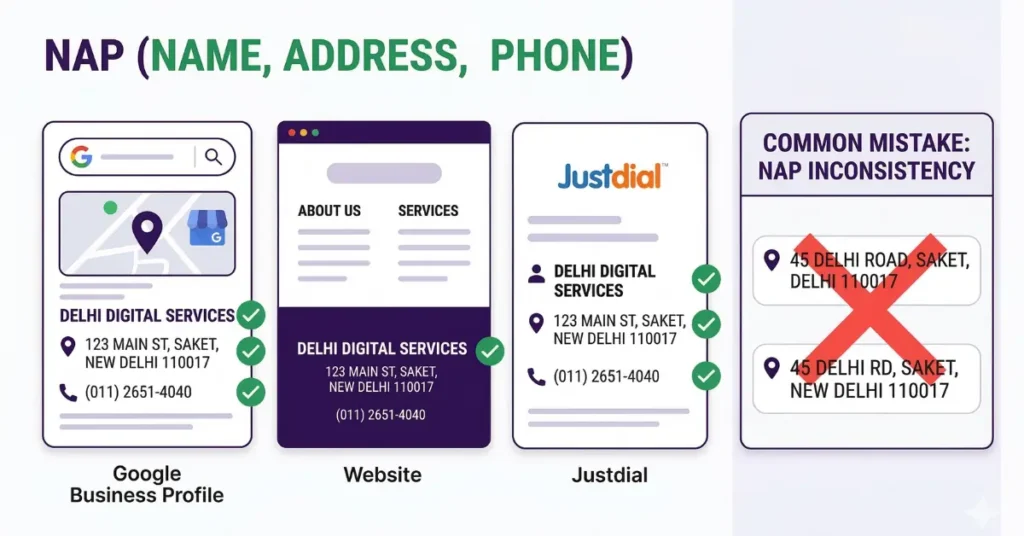
☐ 29. Audit your NAP on your own website
Check footer, contact page, and About page. All three should be character-for-character identical.
☐ 30. Match your GBP NAP exactly to your website — character for character
If your website says ‘Sector 18, Noida — 201301,’ your GBP should say exactly that. Not ‘Sector-18’ or ‘Noida 201301.’ Exactly that.
☐ 31. Fix all directory listings — JustDial, Sulekha, Facebook, Instagram bio
Every inconsistency is a trust signal working against you. Go through them one by one. It is boring work, but it is the kind of boring work that moves rankings.
☐ 32. Never change phone number or address without updating everywhere simultaneously
This is how NAP inconsistency usually happens — a studio moves, updates GBP, forgets the website footer, forgets JustDial. Three months later rankings drop and nobody can figure out why.
SECTION 4 — Reviews Checklist (5 Points)
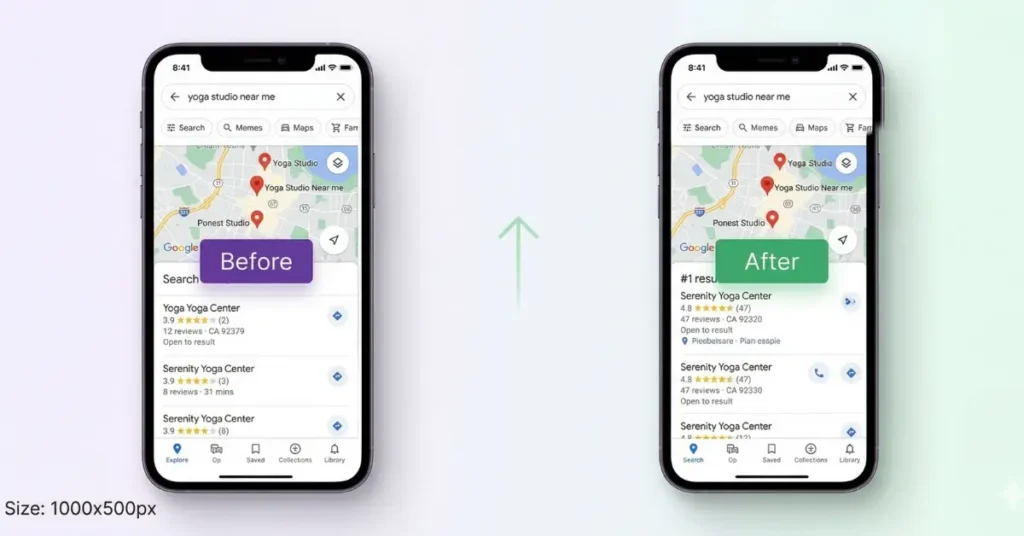
Reviews are the most direct local ranking signal you can influence in the short term. More reviews, higher rating, recent activity — all push you up in the Map Pack. The studios I have seen jump from invisible to top 3 fastest all had one thing in common: a systematic review generation process, not a hopeful one.
☐ 33. Set up a direct GBP review link
Go to your GBP dashboard, find your review link, shorten it with bit.ly or similar, and save it somewhere you can access instantly. This is the link you will send to every student.
☐ 34. Send review requests via WhatsApp — never verbally
Verbal requests get a smile and get forgotten. A WhatsApp message with a direct link gets clicked. Send it after the first month — when the student has had enough time to actually experience results. Keep it personal, not template-sounding.
☐ 35. Share your review link permanently in your class WhatsApp group
Put it in the group description. Pin it. Make it permanently visible and completely frictionless.
☐ 36. Ask at the exact moment of positive emotion
When a student mentions a result — less back pain, better sleep, weight loss, improved flexibility — ask right then. Not at the next session. Not at the end of the month. Right then. They are emotionally open and the request feels completely natural.
☐ 37. Respond to every review — positive and negative
Responding to positives shows engagement. Responding professionally to negatives shows maturity and that you actually care. A well-handled negative review builds more trust than a wall of five-star reviews — which frankly looks curated and suspicious to anyone who has spent time online.
☐ 38. Optimise your WhatsApp Business Profile
Since WhatsApp is your primary review and enquiry channel, treat your WhatsApp Business profile like a mini GBP. Add your exact studio address, website URL, business hours, and a short description that includes your main service and locality. Set up Quick Replies for common questions — batch timings, fees, trial class details. A student who WhatsApps you and gets an instant structured response is significantly more likely to convert than one who waits.
⚠ Never offer discounts or gifts in exchange for reviews. This violates Google’s policies and can get your listing suspended. Ask genuinely. Let the experience speak.
SECTION 5 — Citation Building Checklist (4 Points)
Citations are online mentions of your business name, address, and phone number. They tell Google your business is real, established, and located where it claims to be. You do not need 200 of them. The right 12-15 give you 80% of the benefit.
☐ 39. List on JustDial
Highest domain authority local directory in India. Do this first — before anything else in this section.
☐ 40. List on Sulekha
Strong local search presence, especially for wellness and service-based searches.
☐ 41. Create a complete Facebook Business Page with full address
Even if you never post there, a complete Business Page is a citation. It shows up in branded searches and adds to your overall NAP footprint.
☐ 42. List on Bing Places, Urban Company, and Practo
30 minutes each. Urban Company and Practo have wellness-specific audiences actively searching for yoga. Bing Places is low effort for a small but real traffic source.
If you would rather have the content strategy and SEO handled professionally, our Yoga Studio SEO Services are designed specifically for yoga and wellness businesses — covering keyword research, on-page optimisation, and long-term authority building.
SECTION 6 — Content & Backlinks Checklist (7 Points)
Most studios never get here. They fix GBP, collect a few reviews, and call it done. The studios that dominate local search 12 months from now are the ones publishing content and building local backlinks today. That gap is your opportunity. Most studios never reach this section — which is exactly why it creates such a large gap between those who do and those who do not.
☐ 43. Publish at least one blog per month targeting real search queries
Not generic yoga tips that nobody is searching for. Target real queries: ‘yoga for back pain relief in Delhi,’ ‘how to choose a yoga studio in Noida,’ ‘prenatal yoga benefits — what to expect.’ Each blog is a new page Google can rank. Each one adds topical authority.
Building local backlinks consistently requires ongoing outreach and relationship management — most studio owners simply do not have the time. Our Off-Page SEO Services in Delhi handle citation management, local link building, and authority development as an ongoing process.
☐ 44. Target question-based keywords in your blogs
‘How to promote a yoga studio online,’ ‘seo tips for yoga studio owners,’ ‘how yoga studios get students from Google’ — real searches, low competition, high reader intent. These are the blogs that bring in studio owners who eventually become clients.
☐ 45. Build at least 5-10 local backlinks
Local backlinks carry far more weight than random links from unrelated sites. Get featured on local fitness blogs. Submit to city lifestyle ‘best yoga studios’ lists. Partner with a physiotherapy clinic — ask them to link to your therapeutic yoga page from their back pain blog. Submit workshop events to local event sites. In my experience, even 5-7 well-placed local backlinks can visibly shift Map Pack rankings in less competitive areas. This is the step most studios never take — and it shows.
☐ 46. Check for and fix broken internal links
Use a free tool like Screaming Frog or Ahrefs Webmaster Tools. Broken links waste crawl budget and frustrate visitors. Neither is doing your rankings any favours.
☐ 47. Submit your sitemap to Google Search Console
Your sitemap URL on WordPress is usually yoursite.com/sitemap.xml. Without submitting it, Google may be missing some of your pages entirely — especially newer ones.
☐ 48. Add descriptive alt text to every image on your website
Every image needs alt text that describes what is actually in it — and naturally includes relevant keywords where appropriate. ‘Prenatal yoga class in South Delhi’ not ‘image1.jpg’ or ‘yoga.’ This matters for both image search traffic and accessibility.
☐ 49. Add one external link to a credible source in each blog post
Link to Google’s official GBP page, a government health resource, or a recognised wellness organisation. One quality outbound link per article signals to Google that your content is well-researched and connected to the broader web, not just pointing inward at itself.
The Sequence That Actually Matters
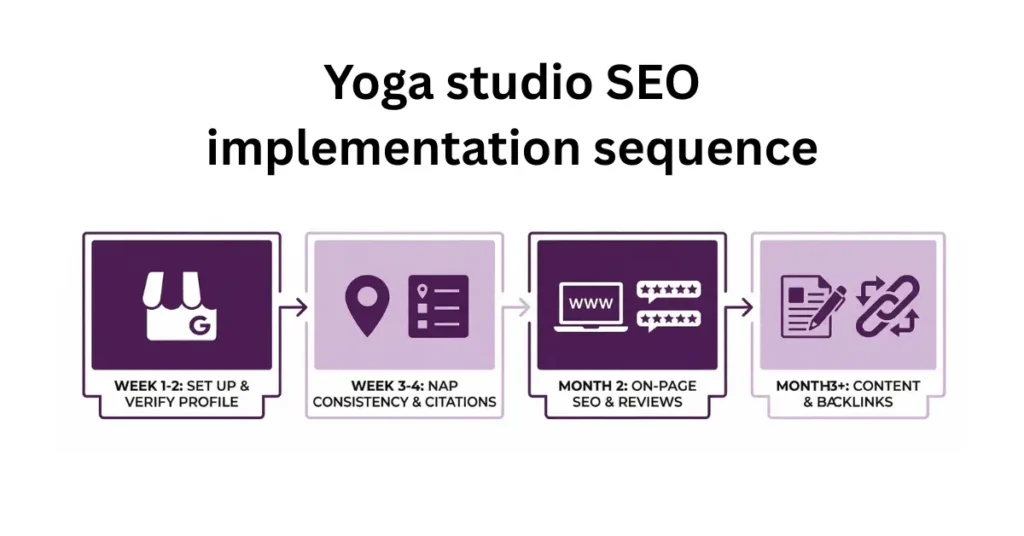
If you are starting from scratch, do not try to do all 49 points at once. You will do nothing properly. Follow this order:
| Timeframe | What to Focus On |
| Week 1–2 | Complete the full GBP checklist (Points 1–13). This alone will start moving your Maps rankings. Nothing else first. |
| Week 3–4 | NAP consistency everywhere (Points 28–31). Citations on JustDial, Sulekha, Facebook (Points 37–40). |
| Month 2 | Website SEO — location pages, title tags, meta descriptions, schema (Points 14–27). Start reviews systematically (Points 32–36). |
| Month 3+ | Content and backlinks (Points 41–49). This is the long game — but it compounds month over month. |
What I have seen fail most often: studios trying to do everything simultaneously, doing nothing properly, and then concluding that ‘SEO does not work.’ SEO works. The studios that fail are not doing it wrong — they are doing it out of order.
Common Mistakes That Undo Everything
I see the same five mistakes repeatedly. Not occasionally — every single time a new studio comes to me.
Running ads before fixing GBP
Ads bring traffic to wherever you send them. If your GBP is incomplete and your website has no location signals, you are paying to send people to a leaky bucket. Fix the bucket first.
Treating this as a one-time project
SEO is not installation — it is maintenance. GBP needs weekly posts. Reviews need ongoing requests. Content needs monthly publishing. Studios that set things up once and disappear plateau within 90 days and then blame the algorithm.
Targeting national keywords instead of local ones
‘Yoga classes’ and ‘yoga for beginners’ are dominated by Cult.fit, national directories, and content farms with thousands of backlinks. You cannot win there and you should not try. ‘Yoga classes in Rohini’ or ‘prenatal yoga near Vaishali Ghaziabad’ — those are winnable. Always go hyper-local first.
Ignoring Hindi and vernacular searches
A significant portion of yoga seekers in India — especially in tier-2 cities and among older demographics — search in Hindi. ‘Yoga sikhne ki jagah paas mein’ is a real search with real volume. Zero studios are optimising for it. That is your opportunity.
Asking for reviews the wrong way
Asking verbally after class gets a warm smile and zero reviews. Sending a WhatsApp message with a direct link — immediately after a student mentions a positive result — gets reviews. The moment and the method both matter.
⚠ The most expensive mistake I see: spending ₹15,000-20,000 a month on Google Ads before the GBP even has the right category set. Local SEO captures people who are already searching for exactly what you offer. Ads bring people you have to convince. The cost-per-enquiry difference, once local SEO is working, is dramatic.
Where Do You Go From Here?
You have the checklist. Now it is time to execute.
Start with a free SEO audit — we will tell you exactly what is holding your studio back.
Prefer to do it yourself? Keep learning
📖 Deep Dive: The Complete Guide to Local SEO for Yoga Studios
📖 Conversion Fixes: Why Your Yoga Studio Gets Traffic But No Leads
Need help implementing this?
We rank yoga studios in 90 days — GBP, website, reviews, done for you.
✉ Get in Touch
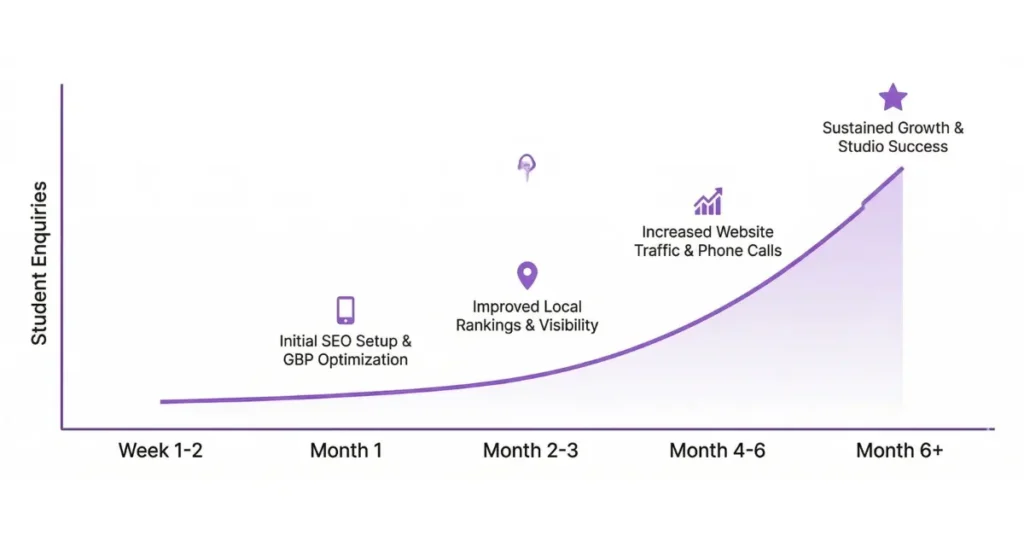
How Long Until You See Results?
Honest expectations — not optimistic, not pessimistic:
| Timeframe | What Happens |
| Week 1–2 | GBP impressions start increasing. You will see it in GBP Insights. |
| Month 1 | First reviews come in. Maps visibility starts improving for your area. |
| Month 2–3 | Ranking for lower-competition local terms. Enquiry calls begin. |
| Month 4–6 | Consistent enquiries from organic search. Map Pack position stabilising. |
| Month 6+ | Compounding — each new review, post, and backlink builds on the last. |
Tier-2 and tier-3 cities: solid visibility in 2-3 months. Delhi, Mumbai, Bengaluru: 4-6 months for competitive keywords. The studios that get there fastest work all three pillars — GBP, website, and reviews — simultaneously from day one. Not sequentially. Simultaneously.
One Last Thing
This checklist exists because most yoga studios get generic advice that does not account for how local search actually works in India — the vernacular searches, the landmark-based queries, the GBP category errors that are costing real students every single day.
Work through it in order. Do not skip sections because they seem obvious. The ‘obvious’ ones are usually the ones that are not actually done.
Your students are already searching. The only question is whether they find you or the studio two streets away.
How Often Should You Run This SEO Audit?
Most yoga studios should run a quick version of this checklist every 3–4 months — not the full 49 points, but a targeted review of the sections most likely to drift: GBP activity, review count and recency, NAP consistency, and website speed. The full audit makes sense twice a year — or whenever you notice a sudden drop in Maps visibility or enquiry volume. Rankings do not usually drop overnight without a reason. A methodical re-check almost always finds it.
Frequently Asked Questions about Yoga Studio SEO Checklist
Is this yoga studio SEO checklist relevant for online yoga classes too?
Yes, with adjustments. For online yoga, deprioritise the Maps and citation sections. Focus instead on website SEO, content targeting national keywords, and building social proof through website testimonials and case studies. Your ‘location’ is your niche and your teaching style — optimise for that.
How often should I update my GBP for yoga studio SEO?
Post at minimum once a week. Update photos monthly. Refresh your business description every quarter or whenever your services or timings change. GBP is not a static directory listing — treat it like a social media profile that Google is actively monitoring for signs of life.
Can I do this myself or do I need to hire an SEO agency?
The GBP checklist, NAP consistency, citations, and review generation are all genuinely DIY-friendly. No technical background needed. Where most studio owners get stuck is website SEO and content — those require more time and some skill. If you can commit 4-5 hours a month, you can maintain solid local SEO yourself. An agency makes sense when you are targeting multiple locations, facing serious competition, or simply cannot stay consistent on your own.
If you decide professional help makes more sense, explore our Local SEO Services in Delhi — we work specifically with yoga studios and wellness businesses across Delhi NCR.
What is the single most important item on this entire checklist?
Setting the correct GBP primary category — ‘Yoga Studio.’ It takes 30 seconds. It is the highest-impact change most studios can make immediately. I have moved clients from page 3 to the Map Pack top 3 with this one change and nothing else. Everything else on this list builds on top of that foundation.
Why is my yoga studio not showing on Google Maps even after setting up GBP?
Most common reasons: wrong primary category, incomplete services section, zero reviews, NAP inconsistency between GBP and website, or a new listing that has not built enough trust signals yet. Work through the GBP checklist section first — fix all 13 points before looking for more complex explanations.
How many Google reviews does a yoga studio need to rank in the Map Pack?
In most Indian cities outside the major metros, 20-30 reviews at 4.5+ rating puts you in a genuinely competitive position. In Delhi, Mumbai, or Bengaluru, plan for 50-80+ for competitive keywords. Recency matters as much as total count — 5 new reviews this month outweighs 50 reviews from 2 years ago in terms of ranking signal. This is why review generation needs to be an ongoing habit, not a one-time push.
I did everything on this checklist but still not ranking. What now?
Three things to check. First, how competitive is your target area? A yoga studio in Connaught Place competing against 40 others is a very different game from one in a residential colony in Ghaziabad. Second, how old is your GBP listing? New listings take 60-90 days to build enough trust signals to rank consistently. Third, how many reviews do your top 3 Map Pack competitors have? If they have 80 and you have 12, that gap is your answer.